2026 Top Wall Acoustic Panels for Global Buyers
Choosing wall acoustic panels in 2026 requires more than comparing colors, prices, and attractive product photographs. Global buyers need solutions that control reverberation, support design goals, and remain practical across different climates, building types, and installation conditions.
This guide examines leading wall acoustic panels for offices, schools, hotels, studios, restaurants, and residential interiors. It considers sound absorption data, NRC ratings, panel thickness, core materials, surface durability, fire performance, moisture resistance, and cleaning requirements. Manufacturer test reports should support every important claim. Details matter. A visually impressive panel may perform poorly in a large, reflective room.
Real project conditions often expose weaknesses that catalogues overlook. A panel suitable for a quiet meeting room may not control noise in a busy restaurant. Fabric finishes can offer warmth, but they may require careful maintenance. PET felt can be lightweight and flexible, although its recycled content and acoustic results should be verified independently. Looks can mislead.
The 2026 selection also considers supply reliability, custom sizing, packaging, installation guidance, replacement access, and after-sales support. Buyers comparing suppliers across regions should confirm product certifications, lead times, warranty terms, and compliance with local building requirements. No single panel suits every room. This overview aims to provide a balanced starting point, combining practical experience, technical evidence, and careful questions for better purchasing decisions. Some rankings may change as testing methods, materials, and market expectations develop. That uncertainty deserves attention.
Wall Acoustic Panels Explained: Types, Materials, and NRC Ratings from 0 to 1
2026 Top Wall Acoustic Panels for Global Buyers
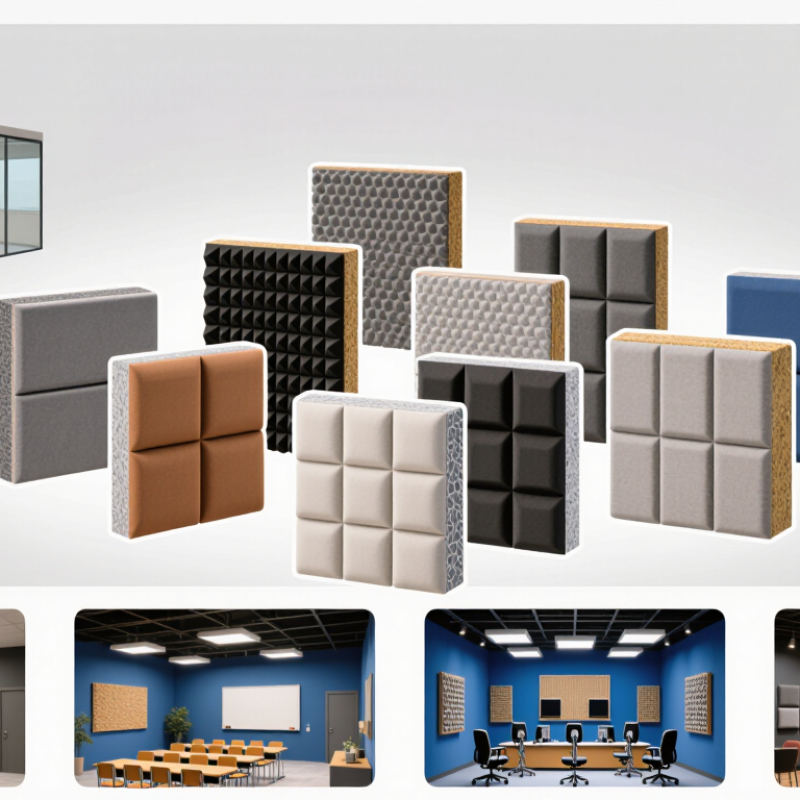
Wall acoustic panels reduce reflected sound, but their performance depends on type, material, thickness, and installation. Fabric-wrapped panels often use mineral wool or polyester fiber cores. They soften speech, meeting noise, and sharp echoes. Wood slat panels add warmth and scatter sound, although their open backing affects absorption. Perforated boards can support stronger mid- and low-frequency control when paired with an acoustic cavity.
NRC, or Noise Reduction Coefficient, ranges from 0 to 1. A rating near 0 absorbs little sound, while a rating near 1 absorbs most tested mid-frequency energy. For example, an NRC of 0.80 suggests strong absorption under laboratory conditions. It does not guarantee identical results in every room. Ceiling height, air gaps, wall coverage, and furniture can change the experience. I have seen highly rated panels perform weakly when installers placed them directly over a hard wall. That detail is easy to miss.
Tips:
Check the test report, not only the product label. Compare thickness and frequency data. Use thicker panels for bass concerns. Leave a small air gap when suitable. Cover early-reflection points near speakers or speaking areas. Measure the room after installation, because human judgment can be unreliable. One test may not tell the whole story.
How Acoustic Panels Work: Absorption, Reverberation, and RT60 Reduction
Wall acoustic panels improve rooms by absorbing reflected sound, not by blocking every outside noise. Their porous cores convert some acoustic energy into small amounts of heat. Hard surfaces, such as glass and concrete, reflect more energy and create longer reverberation.
RT60 measures how long sound takes to fall 60 decibels after the source stops. A handclap in a bare meeting room may linger, blur speech, and make remote calls tiring. ISO 3382-2 defines methods for measuring reverberation in ordinary rooms. The Sabine equation estimates RT60 as 0.161V/A, where V is room volume and A is total equivalent absorption area. More absorption usually means a shorter decay time. Not always perfectly.
The 2023 ANSI/ASA S12.60 classroom standard sets target reverberation times of 0.60 seconds or less for rooms up to 10,000 cubic feet, and 0.70 seconds for larger rooms. These figures help global buyers compare panel layouts with real room needs. The World Health Organization’s 2018 environmental noise guidance also links excessive noise exposure with sleep and communication problems, although it does not prescribe one panel type. Placement matters. Ceiling height matters. A thin panel covering one wall may leave strong reflections from the ceiling and rear wall. Measure before purchasing when possible, then verify RT60 after installation. The result can still disappoint if the room contains loud ventilation or poorly sealed doors.
Comparing Panel Performance: NRC, αw, ASTM C423, and ISO 354 Testing
2026 Top Wall Acoustic Panels for Global Buyers
For global buyers, acoustic ratings need careful interpretation. NRC is a practical average from 250, 500, 1000, and 2000 Hz. It usually comes from ASTM C423 reverberation-room testing. A panel with NRC 0.80 may reduce speech reflections effectively, but it may perform weakly at low frequencies.
ISO 354 measures sound absorption in a reverberation room. Its results can support the weighted absorption coefficient αw under ISO 11654. Unlike NRC, αw uses a reference curve and may include indicators for low-frequency performance. Installation changes everything. An air gap, fabric facing, panel thickness, and edge treatment can alter the result. The numbers are useful, but they are not perfect. A laboratory report cannot fully copy a busy classroom or a hard office corridor.
Tips: Request the full test report, not only a product rating. Check the tested mounting method and panel size. Compare results across the same standard. Ask whether the test used an exposed air gap. For speech-focused rooms, inspect absorption around 500–2000 Hz. For music rooms, review lower-frequency data carefully. I would avoid choosing by NRC alone. The better decision combines verified testing, installation details, fire documentation, and advice from a qualified acoustic professional.
Global Compliance Guide: ASTM E84 Class A and EN 13501-1 Fire Ratings
2026 Top Wall Acoustic Panels for Global Buyers
For global projects, acoustic performance cannot replace fire compliance.
ASTM E84 Class A generally requires flame spread index 0–25 and smoke-developed index 450 or lower. However, Class A does not automatically mean noncombustible. Buyers should request the complete test report, including panel thickness, density, facing, adhesive, and mounting substrate.
EN 13501-1 uses a different classification system. A1 and A2 indicate the strongest reaction-to-fire performance, while B, C, and D represent progressively greater combustibility. Smoke is reported separately as s1, s2, or s3. Flaming droplets use d0, d1, or d2. Therefore, “Class A” and “B-s1,d0” are not interchangeable claims. Check the project’s local code and the exact tested assembly.
Details matter.
During installation, exposed edges, cable openings, and plastic fasteners can change the fire behavior. A panel tested alone may perform differently over plywood or a metal frame. The 2024 Global Status Report for Buildings and Construction reports that buildings and construction consumed about 32% of global energy and produced roughly 34% of global carbon emissions. Lower-impact fibers can help, but fire treatment must remain traceable. Acoustic absorption data should also state the test standard, frequency range, and mounting condition. A 0.90 absorption rating on a suspended sample may not match a tightly mounted wall panel. This is where many product comparisons become optimistic.
2026 Buyer Checklist: Panel Size, Density, Installation, Cost, and Sustainability
2026 Top Wall Acoustic Panels for Global Buyers
For global buyers, panel size should match the room, not the catalogue. A 600 × 1200 mm panel suits modular offices and simplifies shipping. Larger panels reduce visible joints but need stronger handling. Thickness matters more than appearance. Panels between 25 and 50 mm often improve speech control, while an air gap can support lower-frequency absorption. Check test results under ASTM C423, including the Noise Reduction Coefficient, rather than trusting marketing language.
Density requires careful judgment. Higher density does not automatically mean better absorption. Fibrous structure, thickness, and mounting position work together. Request laboratory data tested under ISO 354 when comparing suppliers. Installation should cover reflection zones near desks, meeting tables, and hard sidewalls. Ceiling treatment may be necessary in rooms with glass and concrete. Cost comparisons should include freight, brackets, labor, maintenance, and replacement panels. Cheap panels can become expensive after difficult installation.
Tips:
Measure the room first. Ask for fire, VOC, and acoustic certificates. Review the full product declaration. The UNEP and GlobalABC 2024 Buildings-GSR reported that buildings used about 32% of global energy and produced approximately 34% of global CO2 emissions. Choose recycled content, low-emission binders, and repairable systems where possible. I would still question vague “eco” claims. Sustainability needs documents, not green colors. A small pilot installation can reveal glare, dust, and weak absorption before a full purchase.