+1 877-337-9312 | sale@sflbuild.com

Blog

What Are the Top Sound Insulation Panels?

Choosing the top sound insulation panels starts with identifying the noise you want to reduce. Voices through a shared wall, traffic outside, and echoes inside a room are different problems. The right choice depends on the sound path, the wall or ceiling structure, and the available installation space. A panel that softens speech in a home office may do little against heavy traffic noise. That matters.

Sound insulation and sound absorption are related, but they are not interchangeable. Absorptive panels can reduce reflections, much like a rug softens footsteps in a bare room. Blocking sound often requires added mass, sealed gaps, or changes to the building assembly. Fit matters. This guide compares panel types by their materials, typical uses, installation needs, and available performance information. It also explains which details to check before buying, including published acoustic ratings and the surfaces where a product is suitable. Manufacturer data can help, but results may vary with room layout and installation quality. No single panel is best for every space. Some recommendations may also depend on budget, fire-safety requirements, and whether the work is temporary or permanent. The aim is a practical shortlist, not a promise of silence. A careful choice begins with realistic expectations—and a clear view of what the panels can actually change.
What Are the Top Sound Insulation Panels?

How Sound Insulation Panels Reduce Noise Transmission

What Are the Top Sound Insulation Panels?

Sound insulation panels reduce noise transmission by slowing airborne sound through a wall, ceiling, or door. Mass resists vibration; separated layers and resilient connections reduce direct sound paths. Absorptive material inside a cavity can help limit resonance. Small gaps matter. A narrow crack around a door can undermine a heavy wall. Porous panels attached to a room’s surface mostly reduce echo; they do not necessarily block noise reaching the next room.

The World Health Organization’s 2018 Environmental Noise Guidelines for the European Region recommend road-traffic exposure below 53 dB Lden and 45 dB Lnight. These are health-based outdoor recommendations, not promised results from installing panels. The distinction matters. Real performance depends on the whole assembly, including doors, ceiling edges, and paths around the wall.

Compare tested results for the complete wall assembly, not panel thickness alone. ASTM E90 measures airborne sound transmission in a laboratory, and ASTM E413 uses test results to classify assemblies by Sound Transmission Class. Ask for documentation that matches your wall construction. A lab specimen is not your room, though. Even a well-rated panel may disappoint when installation leaves gaps or sound travels through adjoining structures.


The Main Types of Sound Insulation Panels

Sound insulation panels are not all designed to block sound in the same way. Some absorb echoes inside a room; others help reduce sound passing through walls. That difference matters. A soft panel can make speech clearer, yet do little against a neighbor’s television.

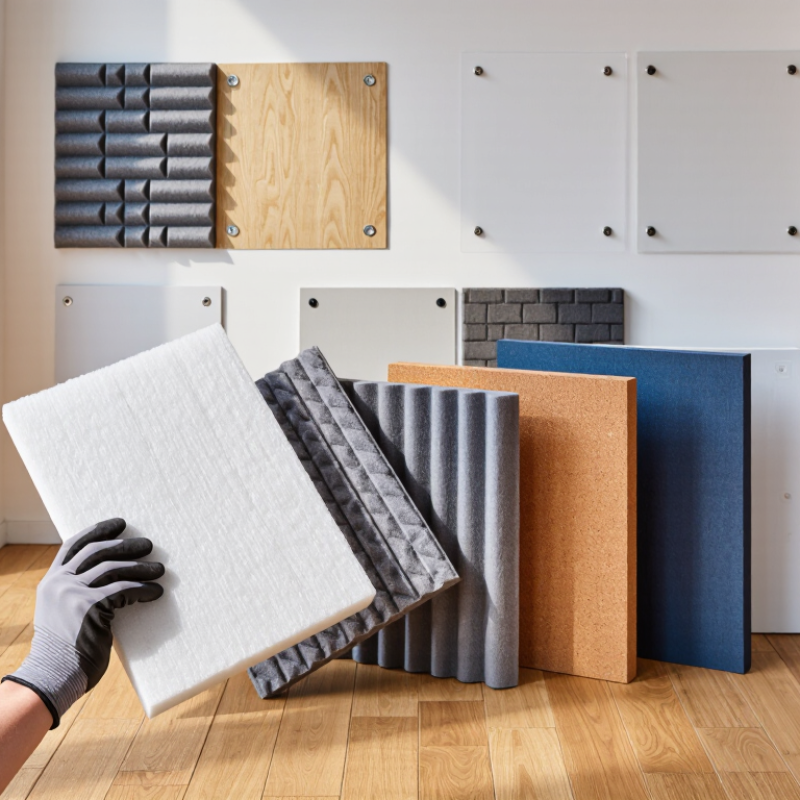
Porous panels made from acoustic foam, mineral wool, or fiberglass absorb sound as it enters their open structure. They are often covered with fabric and mounted on walls or ceilings. In a home office, panels near a desk can reduce the sharp reflections of a video call. Foam is lightweight and easy to fit, but it does not replace a properly built wall. Mineral wool panels tend to be denser, though their installation needs careful handling.

Mass-loaded panels and layered board systems focus more on limiting sound transmission. Their weight can help, especially when seams and edges are sealed well. Some systems use resilient channels or separated layers to reduce vibration traveling through a wall. Small gaps can undermine the result. Honestly, choosing a panel from its thickness alone is tempting, but it can be misleading; the full wall assembly, room layout, and sound frequency all affect performance.

What Are the Top Sound Insulation Panels? — The Main Types

Typical Noise Reduction Coefficient (NRC) ranges for common sound-absorbing panel types. Higher NRC indicates more sound absorption; it does not measure how well a panel blocks sound transmission.

Ranges are indicative, not guaranteed product ratings. Actual NRC depends on panel thickness, mounting, air gap, and construction. For sound isolation between rooms, the performance of the complete wall or ceiling assembly—including airtightness and mass—is what matters.

Key Features Used to Compare Top Panel Options

What Are the Top Sound Insulation Panels?

Key Features Used to Compare Top Panel Options

Compare panels by their purpose before comparing their ratings. Absorption panels reduce reflections inside a room; they do not necessarily block sound passing through a wall. ASTM C423 laboratory reports measure sound absorption in a reverberation room. The Noise Reduction Coefficient, or NRC, summarizes absorption at 250, 500, 1,000, and 2,000 Hz. An NRC of 0.80 suggests strong average absorption across those bands, but it is a rounded rating, not a promise of 80% less noise.

Check frequency-specific results, thickness, and mounting details. A thin panel may control speech echoes but do little for lower-frequency rumble. Look for test conditions in the report: an air gap behind a panel can change its measured performance. Small details matter. For sound passing through partitions, compare transmission-loss data instead. ASTM E90 describes a laboratory method for measuring transmission loss; ASTM E413 explains how Sound Transmission Class ratings are classified. These figures answer different questions, so treating NRC and STC as interchangeable can lead to a poor choice.

Coverage and installation deserve equal attention. A few panels placed near a hard desk or bare wall may tame a sharp echo, while untreated ceilings and corners still reflect sound. Compare fire-performance documentation, edge durability, and cleaning requirements for the actual room. I would not choose by the highest rating alone; lab results cannot fully reproduce every room, and that limitation is easy to overlook.

How to Choose Panels for Different Noise Problems

What Are the Top Sound Insulation Panels?
How to Choose Panels for Different Noise Problems

Choose panels by the path and type of noise, not by appearance alone. For echo in a home office, studio, or restaurant, porous acoustic panels absorb reflections and make speech clearer. Their absorption is commonly measured under ASTM C423, including through the Noise Reduction Coefficient. For voices or television passing through a wall, absorption alone may do little. Look instead at the complete wall or ceiling assembly’s sound-transmission performance, measured in laboratories using ASTM E90 and classified under ASTM E413. Measure before buying.

For traffic rumble, bass, or a neighbour’s footsteps, identify the route: through a window, a thin partition, a floor, or a gap around a door. Dense, well-sealed construction generally matters more for blocking airborne sound; impact noise may require floor or ceiling treatment. A panel stuck on one wall rarely fixes every route. I would check joints and vents, too.

Use exposure data as context, not as a promise that one panel will solve the problem. The World Health Organization’s 2018 Environmental Noise Guidelines recommend keeping average road-traffic exposure below 53 dB Lden and nighttime exposure below 45 dB Lnight. These are outdoor exposure recommendations, not product ratings. Ask for test results for the exact panel assembly, and note whether the data cover low frequencies. That detail is easy to miss.

Installation Factors That Affect Sound Insulation Performance

Sound insulation panels work best when they form part of a complete wall or ceiling assembly. Their performance depends on more than the panel material. Check the product’s tested rating, then compare it with the noise you need to reduce. Airborne voices and low-frequency traffic noise behave differently.

Fit the panels closely, but do not compress soft materials unless the installation instructions allow it. Leave no open seams around edges, outlets, pipes, or framing; even a narrow gap can let sound pass through. Small gaps matter. Use compatible sealant around perimeter joints, and cover electrical openings carefully without blocking ventilation or creating hazards. A heavy panel attached to weak plaster may loosen, so confirm that fasteners reach suitable framing or approved anchors. For ceilings, account for the added weight before installation.

Decoupling can help limit vibration, but rigid screws that bridge an isolated layer may reduce its benefit. Follow the assembly details rather than mixing parts by guesswork. Check that the wall is dry and stable, and repair leaks or loose boards first. I would also inspect the room after installation: a rattling vent or untreated door can remain the weak point. That part is easy to miss. A small test area can reveal awkward seams or fit problems before you cover the whole surface.

What Are the Top Sound Insulation Panels? - Installation Factors That Affect Sound Insulation Performance
Panel or System Type How It Helps Installation Factor Effect on Performance Best Use and Limitation
Double-layer gypsum board Added mass can reduce sound transmission through a wall or ceiling; damping between layers can further reduce panel vibration. Stagger board joints between layers and seal perimeter edges, electrical boxes, and other openings. Gaps and aligned joints can create sound leaks that undermine the benefit of the added layers. Useful in wall and ceiling assemblies. Results depend on the full assembly, including framing, cavities, and connections.
Mass-loaded vinyl barrier A flexible, dense barrier adds mass without requiring a thick rigid panel. Install it continuously, overlap or join seams as specified, and seal edges and penetrations. Unsealed seams, tears, or gaps let sound bypass the barrier; fastening details can also affect performance. Can be used as part of a wall, ceiling, or enclosure assembly. It is not a substitute for correcting structural flanking paths.
Mineral wool cavity panels or batts Absorb sound energy within a stud or joist cavity and help reduce cavity resonance. Fit the material evenly without leaving voids or compressing it excessively; maintain the designed cavity depth. Voids reduce cavity absorption. Mineral wool alone does not provide the mass or airtightness of a sound-isolating barrier. Most effective as a component of a complete wall or ceiling assembly with suitable surface layers and sealed joints.
Resiliently mounted gypsum board Resilient channels or isolation clips reduce direct vibration transfer between framing and the finished surface. Follow the specified fastener locations and lengths; screws must not accidentally connect the board directly to the framing. A single rigid connection can short-circuit the isolation and significantly reduce its effectiveness. Useful where structure-borne sound transfer is a concern. Requires careful installation and compatible assembly details.
Acoustic composite barrier panels May combine a dense barrier with an absorptive layer to address sound transmission and reflections within an assembly. Install the correct face orientation, join panels closely, and seal joints and perimeter gaps. Open joints or incorrect orientation can reduce the intended barrier or absorption effect. Performance varies by construction and tested assembly; check product test data for the intended wall or ceiling application.
Fabric-wrapped acoustic panels Absorb reflected sound in a room, helping reduce echo and reverberation. Cover the intended reflective area and mount securely; use a properly designed backing or cavity where specified. Placement affects room absorption, but these panels generally do not block substantial sound transmission through a wall. Best for improving room acoustics, not as a stand-alone soundproofing layer between rooms.

Important: Sound isolation is determined by the complete construction, not by a panel alone. Airtight seals, junction details, framing, flanking paths, and correct installation all affect real-world results. Compare test data for complete assemblies where available.