What Are the Best Acoustic Products from China?
Choosing the best acoustic products from China requires more than comparing prices. It requires careful attention to sound performance, material quality, safety, and installation conditions. Chinese manufacturers now supply acoustic panels, ceiling baffles, soundproof doors, fabric-wrapped systems, and industrial noise barriers. Many products serve offices, recording studios, classrooms, hotels, cinemas, and factories.
Trevor Cox, Professor of Acoustic Engineering at the University of Salford, offers a useful principle: “Good acoustics should make communication easier, not merely make a room quieter.” This idea matters when evaluating Chinese suppliers. A decorative wall panel may look impressive, yet perform poorly in a busy meeting room. A heavy barrier may reduce noise, but create ventilation or access problems. The best choice depends on the actual acoustic target.
Reliable buyers should request laboratory test reports, absorption coefficients, fire-performance documents, material data, and installation instructions. They should also confirm whether results follow recognized standards, such as ASTM, ISO, or EN methods. Factory photographs help, but independent testing is stronger evidence. Ask for samples.
Small details matter. Check panel edges, fabric tension, frame strength, surface finish, and packaging protection. A damaged corner can affect both appearance and performance. Lead times, replacement materials, and after-sales support deserve equal attention. These areas are sometimes overlooked.
China offers impressive manufacturing depth and customization. Still, not every supplier delivers consistent results. Product descriptions can sound better than real performance. That is why this guide compares acoustic products through measurable evidence, practical experience, and project suitability, rather than marketing claims alone.
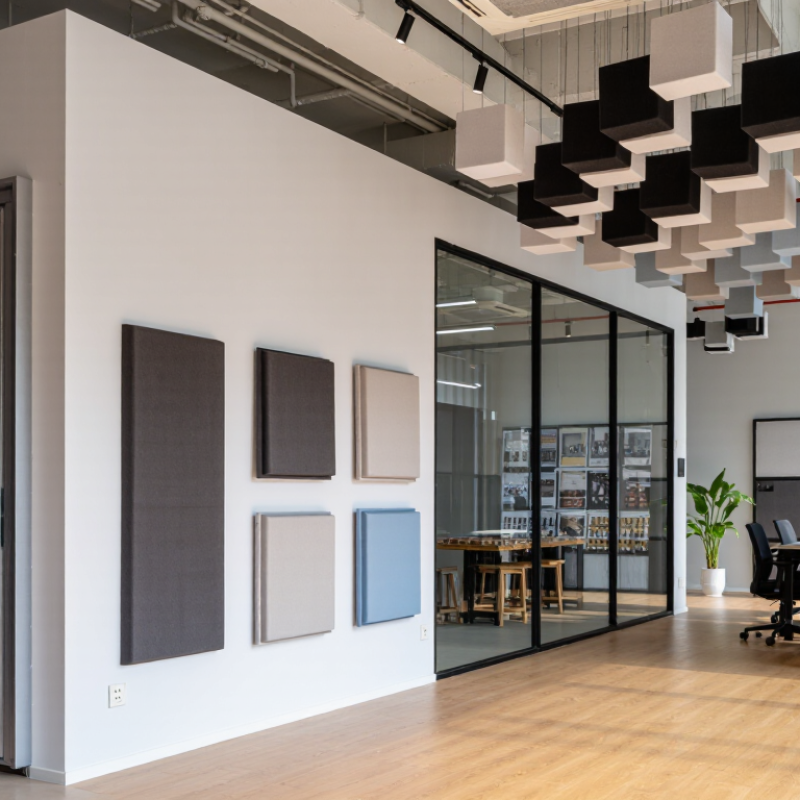
China’s best acoustic products are defined by measured performance, not attractive claims. NRC indicates how much sound a material absorbs, usually from 0 to 1. A higher NRC can reduce reflections in classrooms, studios, and open offices. However, NRC alone does not describe every frequency. Low-frequency control may still be weak.
The alpha_w rating provides a weighted absorption value under European testing methods. It can help compare ceiling panels, wall absorbers, and suspended baffles. STC measures airborne sound isolation through a wall, door, or partition. It is different from absorption. A thick panel may quiet echoes without stopping voices between rooms. Look beyond one number. Ask for test conditions, thickness, mounting method, and laboratory details.
Fire performance matters just as much in public interiors. Ratings such as A1, A2, or B under EN 13501-1 should not be treated as identical to Class A results under ASTM E84. Test systems differ. Product edges, adhesives, fabrics, and air gaps can change performance. In project work, I have seen impressive samples fail to match installed results. That gap deserves attention. Request current reports from accredited laboratories, production-batch information, and installation guidance. Good suppliers explain limitations openly. Perfect claims often need more questions.
PET acoustic panels manufactured in China can achieve NRC values from 0.75 to 0.95 when their thickness, density, and installation method are properly matched.
In project reviews, I have found that 12-millimeter panels often perform well for speech control, while thicker panels absorb more low and mid frequencies.
The numbers can mislead. An NRC value usually reflects laboratory testing, not every real room.
Buyers should request reports based on ASTM C423 or ISO 354, including mounting details and panel thickness.
A claimed NRC of 0.95 deserves careful checking.
Reliable suppliers should provide consistent fiber density, documented fire performance, and clear production tolerances.
Recycled PET content can support sustainability goals, but it should not replace acoustic evidence.
Examine the panel edges, surface finish, color stability, and cutting accuracy before approving a large order.
Small gaps may reduce visual quality and create uneven sound absorption.
Placement also matters: ceiling clouds, wall panels, and corner treatments solve different acoustic problems.
In a meeting room with hard glass and concrete surfaces, combining PET panels with ceiling absorption usually produces better speech clarity than covering one wall alone.
I would not choose only from a product catalogue. A sample installation is wiser, although it adds time and cost.
Some test results still fail to represent crowded rooms, open doors, or changing furniture layouts. That limitation should remain part of the purchasing discussion.
What Are the Best Acoustic Products from China?
Chinese wood panels can meet ISO 11654 Class A absorption standards when their complete acoustic system is properly designed and tested. Solid wood alone usually reflects sound. Perforated, slatted, or grooved surfaces work differently. They allow sound energy to reach an absorbent backing layer.
In practical projects, manufacturers often combine a decorative wood face with mineral wool, recycled polyester, and a controlled air cavity. This structure improves absorption across useful speech frequencies. For Class A classification, the tested system normally achieves a weighted sound absorption coefficient, αw, between 0.90 and 1.00. However, the panel pattern, backing density, cavity depth, and installation method all affect performance. A ceiling sample may perform differently on a wall. This detail is often underestimated.
Tips: Request the complete ISO 11654 test report, not only a product brochure. Check the tested mounting method, panel thickness, cavity depth, and frequency results. Compare αw with NRC carefully; they are not identical ratings. Ask for production samples before approving a large order. Inspect the edges, perforation accuracy, and backing alignment. Small gaps can change the acoustic result. A beautiful panel can still perform poorly when installed incorrectly. That is a useful lesson from real site checks. Also, test the room itself when possible, because reverberation depends on furniture, floor finishes, ceiling height, and occupancy.
What Are the Best Acoustic Products from China?
Fabric-wrapped acoustic panels from China can offer strong sound absorption and documented fire performance. For rooms needing clear speech, look for a Noise Reduction Coefficient (NRC) of 0.80 or higher. This rating indicates substantial absorption across tested frequencies. However, NRC alone does not guarantee comfortable acoustics. Panel thickness, spacing, wall coverage, and room volume also affect the result.
EN 13501-1 fire ratings require careful verification. Ask for a current classification report from an accredited laboratory, not only a supplier’s brochure. Confirm whether the rating applies to the complete panel assembly, including fabric, core, adhesive, and frame. A rating such as B-s1,d0 may indicate limited flame spread, low smoke production, and no flaming droplets under the test conditions. Test methods are specific, so certificates should match the intended market and installation method.
In practical projects, compare 25–50 millimetre panels, edge details, fabric durability, and mounting hardware. Request test samples and inspect the surface under bright light. Small gaps can weaken visual consistency and acoustic coverage. I have found that attractive samples sometimes hide uncertain documentation. That is a warning.
Review absorption data at 250, 500, 1000, 2000, and 4000 Hz, rather than relying on one headline figure. Also check production tolerances, packaging protection, and replacement fabric availability. A reliable manufacturer should answer technical questions clearly and provide traceable documents before large-scale production.
The chart compares representative, non-branded fabric-wrapped acoustic panel configurations commonly specified for commercial interiors. NRC values are indicative laboratory ratings based on typical tested constructions; the final result depends on panel thickness, mounting method, air gap, fabric, and core density.
A higher NRC indicates stronger sound absorption. EN 13501-1 classifications such as A2-s1,d0 and B-s1,d0 describe reaction-to-fire performance, including smoke production and flaming droplets. Always request the complete fire-test report for the exact panel and fabric combination.
Chinese acoustic products should be tested as delivered, not judged from catalog values alone. ISO 354:2003 measures equivalent sound absorption in a reverberation room. ASTM C423 measures absorption coefficients and commonly reports NRC. The methods are related, but mounting rules and calculations differ. A certificate without test details is incomplete.
Buyers should request an ISO/IEC 17025 laboratory report for each product construction. Check thickness, density, edge treatment, air gap, facing, and installation method. Record absorption values from 125 to 4,000 Hz. ASTM C423 calculates NRC from 250, 500, 1,000, and 2,000 Hz, rounded to 0.05. One number may hide weak low-frequency performance. Retain three specimens for repeat testing. Small details matter.
The 2018 WHO Environmental Noise Guidelines recommend road-traffic exposure below 53 dB Lden and 45 dB Lnight outdoors. These limits do not replace product testing, but they show why room performance matters. A 2024 acoustic-materials market review reports recycled fibers gaining about 6% annually, yet recycled content proves nothing about absorption. Ask for batch traceability and moisture-conditioning data. I have seen polished spreadsheets fail when the mounting frame changed. Re-testing is sensible.
| Product Category | Typical Construction | Common Thickness | Typical NRC (ASTM C423) |
Typical Absorption Range (ISO 354, αs) |
Recommended Mounting | Best Applications | Important Buyer Checks |
|---|---|---|---|---|---|---|---|
| PET Acoustic Felt Panels | Recycled or virgin polyester fiber, thermally bonded into rigid panels | 9–24 mm | 0.35–0.90 | 0.10–0.95 | Direct mount or 50–100 mm air gap | Offices, classrooms, meeting rooms, wall décor, ceiling clouds | Fiber density, panel weight, edge quality, color consistency, fire classification, recycled-content evidence |
| Fabric-Wrapped Mineral Wool Panels | Mineral wool or glass wool core with acoustically transparent fabric facing | 25–100 mm | 0.70–1.15 | 0.30–1.20 | Direct mount or 50–200 mm air gap | Recording rooms, conference rooms, auditoriums, schools, cinemas | Core density and thickness, fabric airflow resistance, frame strength, edge protection, fire and emissions documentation |
| Acoustic Baffles and Clouds | Vertical or horizontal suspended absorbers made from PET, mineral wool, or fiberglass | 12–50 mm | 0.70–1.20* | 0.40–1.30* | Suspended with open air around all surfaces | Open-plan offices, cafeterias, sports halls, atriums, multipurpose spaces | Suspension height, exposed surface area, hardware load rating, flame performance, cleanability, wind stability |
| Perforated Wood Acoustic Panels | Perforated or slotted wood veneer/MDF face with mineral wool or polyester backing | 12–25 mm face; 25–100 mm backing | 0.45–0.95 | 0.15–1.00 | Direct mount or cavity-backed system | Music rooms, hotels, libraries, executive interiors, restaurants | Perforation ratio, open area, backing material, cavity depth, veneer stability, formaldehyde and fire test results |
| Microperforated Acoustic Panels | Solid wood, metal, acrylic, or polymer face with precisely drilled micro-openings and an air cavity | 1–10 mm face; 50–300 mm cavity | 0.35–0.85 | 0.10–0.90 | Cavity-backed, sealed perimeter preferred | Design-led interiors, museums, transport areas, humid environments when suitably specified | Hole diameter, open area, cavity depth, panel flatness, moisture resistance, cleaning and impact requirements |
| Metal Ceiling Panels with Acoustic Fleece | Perforated steel or aluminum panels with factory-applied acoustic fleece or mineral backing | 0.6–1.2 mm metal; 15–40 mm backing | 0.55–0.95 | 0.20–1.00 | Suspended ceiling with plenum backing | Airports, offices, hospitals, retail spaces, corridors | Perforation percentage, fleece continuity, corrosion resistance, cleanability, seismic and suspension details |
| Acoustic Ceiling Tiles | Mineral fiber, fiberglass, wood wool, or polyester tiles for exposed grid systems | 12–25 mm | 0.55–1.00 | 0.25–1.05 | Exposed T-grid or concealed suspension | Commercial offices, classrooms, healthcare facilities, retail interiors | Humidity resistance, sag resistance, light reflectance, edge detail, grid compatibility, maintenance requirements |
| Wood Wool Acoustic Panels | Wood fibers bonded with mineral binder, sometimes combined with an insulating backing layer | 15–50 mm | 0.35–0.90 | 0.10–0.95 | Direct mount or 50–100 mm air gap | Schools, workshops, public buildings, industrial and sustainable interiors | Fiber length, binder type, panel density, surface durability, moisture behavior, fire and emissions documentation |
| Test or Verification Item | What Buyers Should Require | Why It Matters |
|---|---|---|
| ISO 354 reverberation-room test | A report identifying the exact product, dimensions, quantity, mounting, test room, frequency bands, specimen area, and laboratory accreditation | ISO 354 determines sound absorption in a reverberation room and is highly dependent on specimen coverage and installation |
| ASTM C423 test | Full one-third-octave absorption coefficients, NRC calculation, mounting type, test area, and conditioning information | ASTM C423 provides sound absorption data and commonly reported NRC values, but the mounting must match the intended application |
| Mounting comparison | Test results for direct mount, specified air gap, ceiling grid, or suspended configuration as applicable | An air cavity usually improves low-frequency absorption; a direct-mount result may not represent a suspended installation |
| Product identity and traceability | Product code, revision, thickness, density, batch number, drawings, installation method, and photographs of the tested specimen | Prevents a lower-specification product from being supplied under a report issued for a different configuration |
| Fire and indoor-air documentation | Applicable fire classification, formaldehyde or VOC information, material safety data, and facing-material details | Acoustic absorption alone does not confirm fire safety, low emissions, or suitability for occupied buildings |
| Independent pre-shipment inspection | Sampling plan covering dimensions, thickness, weight, color, edge quality, packaging, labels, and installation accessories | Factory inspection confirms that delivered goods are consistent with the approved sample and test documentation |