Blog
Top Acoustic Sound Panels Manufacturers in China
Acoustic sound panels can make a room feel calmer, clearer, and more comfortable. Yet choosing them is not as simple as comparing prices or colors. A panel that softens speech in a small meeting room may not solve the echo in a restaurant or music studio. Room size, surface materials, panel thickness, and placement all matter. Small details matter.
Professor Trevor Cox, an acoustics researcher at the University of Salford, has helped explain how sound interacts with the spaces around us. A practical takeaway from his work is that effective acoustic treatment starts with understanding the room, not simply selecting a product. That distinction is useful when comparing manufacturers. A reliable supplier should explain absorption ratings, available materials, installation options, and the conditions behind its performance claims. Ask for test data, not just a polished catalogue.
China has a broad manufacturing base, with companies offering different designs, price points, and levels of technical support. Some focus on PET felt panels, while others make fabric-wrapped, wood-finish, or customized products. Their capabilities can vary. This guide to the top acoustic sound panels manufacturers in China looks beyond appearance to examine product range, production experience, quality documentation, and communication with buyers. It also recognizes a limitation: published specifications do not always show how a panel will perform in a particular room. Careful selection—and, where possible, a real-world sample—can prevent costly assumptions.
Understanding Acoustic Sound Panels and Their Main Applications
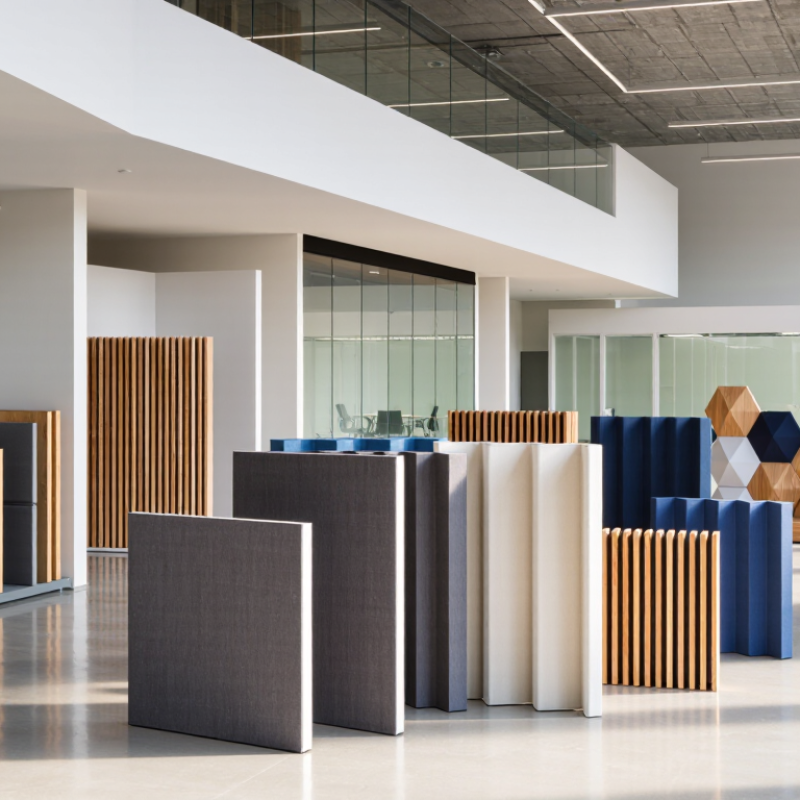
Acoustic sound panels manage reflected sound inside a room. They absorb part of the sound energy that would otherwise bounce off hard walls, ceilings, and glass. The result can be clearer speech and less lingering echo. They do not block noise passing through walls. That distinction matters.
Material, thickness, and placement all affect performance. Porous panels made with acoustic foam or mineral fiber are common, while fabric coverings can suit visible interior spaces. In a meeting room, panels near speaking areas may help reduce distracting reflections. A classroom often benefits from treatment on both walls and the ceiling, where children’s voices can otherwise build into a blur. In recording rooms, careful placement can make vocals easier to control. More panels are not always better.
Restaurants and open offices use panels to soften busy sound, but layout still matters. A panel hidden behind a tall cabinet may contribute little to the listening area. Installers often assess the room’s surfaces and typical noise sources before choosing coverage. Small test installations can reveal unexpected results. Even well-chosen panels may leave low-frequency rumble largely unchanged, so expectations should stay realistic. Practical room planning is rarely perfect on the first attempt.
Top Acoustic Sound Panels Manufacturers in China - Understanding Acoustic Sound Panels and Their Main Applications
| Panel type | Common construction | Typical thickness | Main applications | Key selection considerations |
|---|---|---|---|---|
| Fabric-wrapped absorber | Porous fiberglass or mineral-wool core covered with acoustically transparent fabric | Commonly 25–50 mm | Offices, meeting rooms, classrooms, studios, and auditoriums | Check the tested absorption data, fabric durability, edge finish, and any required fire-performance documentation. |
| PET felt panel | Panel made from compressed polyester fibers, often including recycled PET content | Often 9–24 mm; thicker designs are also available | Offices, classrooms, shared workspaces, and decorative wall or ceiling installations | Confirm the tested acoustic performance, fiber composition, mounting method, and applicable fire rating. |
| Perforated wood panel | Perforated or slotted wood-based facing, generally paired with an acoustic backing and an air cavity | Facing and backing vary by design; the installed assembly determines overall depth | Conference rooms, lecture halls, performing-arts spaces, and commercial interiors | Hole or slot pattern, backing material, cavity depth, finish, and complete-system test results affect performance. |
| Acoustic foam panel | Open-cell foam, commonly shaped with a flat, wedge, or pyramid surface | Commonly 25–50 mm | Small studios, voice rooms, and selected sound-control applications | Review fire and smoke documentation and frequency-specific test data; foam does not block sound transmission through walls. |
| Ceiling baffle or cloud | Suspended absorptive panels installed vertically as baffles or horizontally as clouds | Varies by panel design and suspension system | Large open offices, cafeterias, gyms, and other spaces with exposed ceilings | Consider suspension safety, ceiling height, spacing, cleaning access, and absorption from multiple exposed faces. |
| Perforated metal panel | Perforated metal facing combined with an absorptive infill or backing layer | Assembly depth depends on facing, infill, and cavity design | Transport facilities, industrial interiors, public buildings, and areas needing a robust surface | Check corrosion resistance, perforation pattern, backing protection, cleanability, and tested assembly performance. |
Note: Thicknesses are common product ranges, not performance guarantees. Acoustic absorption depends on the panel construction, mounting method, air cavity, room conditions, and test method. Absorptive panels reduce sound reflections within a room; they are not, by themselves, soundproofing barriers.
Related Posts
-
China Best Noise Panels for Global Buyers
-
Top 10 Soundproof Panels for Noise Reduction?
-
How to Choose Noise Reduction Panels in 2026?
-
Top 10 Benefits of Using Interior Acoustic Panels for Your Home?
-
Top 5 Acoustic Panels Ceiling Tips for Better Sound Quality?
-
What is wall acoustic panels and how do they improve sound quality?