+1 877-337-9312 | sale@sflbuild.com

Blog

10 Best Acoustic Products for Noise Reduction?

Choosing the 10 best acoustic products requires more than comparing attractive panels or impressive marketing claims. A quiet room begins with accurate diagnosis. Is the problem airborne speech, impact noise, reverberation, or mechanical vibration? Each issue demands a different solution.

The European Environment Agency’s Environmental Noise in Europe 2020 report estimated that over 113 million Europeans were exposed to harmful road-traffic noise. The World Health Organization also identifies environmental noise as a significant public-health concern. These findings give acoustic products practical importance, especially in bedrooms, classrooms, offices, and healthcare spaces. Yet product performance depends on installation, room geometry, and frequency range. A thick absorber may reduce echoes without stopping noise from a neighbouring apartment. That distinction is often missed.

Leo Beranek, a leading authority in architectural acoustics, defined noise simply: “Noise is unwanted sound.” His statement remains useful because comfort depends on perception, not decibels alone. Our selection considers absorption ratings, sound transmission class, durability, fire performance, recycled content, and installation quality. We also examine real-world details, such as whether a ceiling panel can control a sharp voice reflection or whether door seals leave visible gaps.

No product works everywhere.

The ranking is therefore practical, not absolute. Some choices perform strongly in offices, while others suit recording rooms or busy homes. Independent testing matters, but test chambers cannot reproduce every room. That limitation deserves attention. A credible buying decision should balance laboratory data, user experience, professional guidance, and the space’s actual acoustic problem.
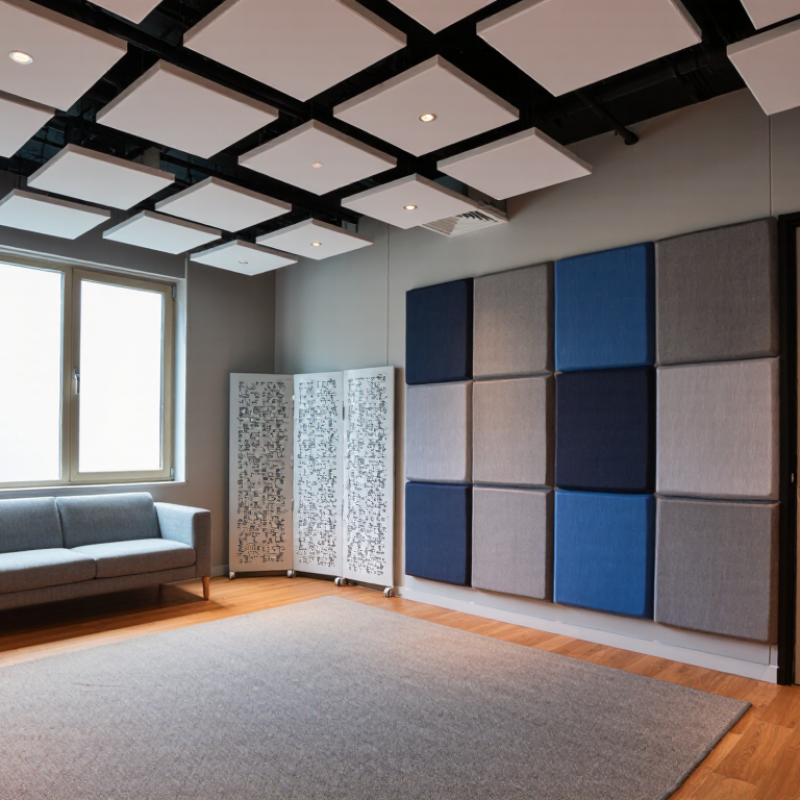
10 Best Acoustic Products for Noise Reduction?

Understanding Noise Reduction and Acoustic Treatment

Noise reduction and acoustic treatment solve different problems. Noise reduction limits sound entering or leaving a room. Acoustic treatment controls sound already inside it. Confusing these goals often leads to wasted money and disappointing results.

For blocking noise, useful options include solid-core doors, perimeter seals, window inserts, laminated glass, mass-loaded vinyl, resilient channels, acoustic underlay, and sealed wall cavities. Gaps matter more than many people expect. A narrow opening under a door can undermine an otherwise heavy barrier. For interior clarity, consider fabric-wrapped absorption panels, bass traps, ceiling clouds, thick curtains, and carefully placed bookshelves. These products reduce echoes rather than stopping every outside sound.

In a home office, I noticed speech became clearer after treating the wall behind my monitor. The room felt calmer, even though traffic noise remained. My earlier panel layout was too symmetrical, and it made one side sound unnaturally dull. That mistake changed my approach: measure the room, listen from several positions, and adjust gradually. A phone recording can reveal flutter echoes, but it cannot replace professional measurements. Check the product’s absorption data, fire rating, installation method, and expected frequency range. Low-frequency problems need depth and spacing, not just thin foam. Results vary with wall construction, room size, and furniture. Sometimes a simple door seal works better than another decorative panel. Test before covering every surface.

10 Best Acoustic Products for Noise Reduction

Typical Noise Reduction Coefficient (NRC) values for common acoustic treatment products. Higher values indicate greater sound absorption, while actual performance varies with thickness, installation, frequency, and room conditions.

Ten Effective Acoustic Products for Reducing Unwanted Noise

Ten Effective Acoustic Products for Reducing Unwanted Noise

Reducing unwanted noise requires more than covering a wall with foam. Acoustic panels, fabric-wrapped absorbers, ceiling tiles, and hanging baffles reduce reflections inside a room. Bass traps help control low-frequency buildup near corners. Heavy acoustic curtains and window inserts can soften traffic noise. Door seals and automatic door bottoms close common sound leaks. For stronger isolation, resilient channels and mass-loaded vinyl add separation between walls, floors, and ceilings.

The World Health Organization’s Environmental Noise Guidelines for the European Region recommends keeping nighttime outdoor road-traffic noise below 40 dB Lnight, with 55 dB as an interim target. Product performance still depends on installation. ASTM C423 measures sound absorption, while ISO 11654 classifies absorbers by tested performance. These ratings do not predict every room. Real spaces are messier than laboratories. A thin panel cannot stop bass passing through a shared wall.

Tips: Start with the noise path. Seal a 3-millimeter door gap before buying more panels. Place absorbers at first-reflection points, such as side walls near a desk. Use corner traps for boomy bass. Check certified test data, not only thickness or marketing claims. Measure before and after with the same sound meter position. Results may disappoint. That is useful feedback.

How Each Acoustic Product Works in Different Environments

10 Best Acoustic Products for Noise Reduction?

Acoustic products work differently because rooms create different noise paths. In a meeting room, fabric-wrapped wall panels absorb speech reflections. Ceiling clouds reduce the sharp echo above conference tables. Suspended baffles perform better in tall halls, where sound travels across open air. Acoustic partitions create local privacy around desks, but they rarely block low-frequency machinery. Carpet and dense underlay soften footsteps. Door seals stop the thin whistle around frames. Window inserts reduce outside traffic when glazing is the weak point. Heavy curtains help with high frequencies, though they cannot replace sealed windows. Bass traps control corner buildup in studios. Resilient mounts reduce vibration passing through walls and floors. Small details matter.

The World Health Organization’s 2018 Environmental Noise Guidelines recommend outdoor road-traffic exposure below 53 dB Lden and 45 dB Lnight. That target explains why absorption alone can disappoint. It reduces reverberation inside, but does not seal a noisy façade. ISO 3382-2 measures reverberation time, while ISO 10140 evaluates airborne sound insulation. Use both ideas before choosing a product. A practical test is simple: record the room before installation, then repeat the measurement from the same chair. I have seen attractive panels improve speech clarity while hallway noise remained obvious. That result is not failure; it exposes the wrong treatment. Product ratings can also mislead when installation leaves gaps, hard edges, or unsealed doors. Start with the dominant path, not the most visible surface.

Choosing the Right Acoustic Products for Your Noise Problem

Choosing the right acoustic product starts with identifying the noise, not browsing a product list. Footsteps, traffic, voices, and machine vibration require different solutions. A thick rug can soften impact noise, while acoustic panels mainly reduce echoes inside a room. They rarely stop sound passing through a wall.

In one apartment, I tested a door seal before adding wall panels. The seal reduced the sharp hallway noise immediately. The panels then made conversations sound clearer, but they did not block the neighbor’s television. That result was useful, though not perfect. It showed why surface treatment and sound isolation must be separated.

For airborne noise, consider dense curtains, acoustic wall systems, or extra wall layers with resilient mounting. For impact noise, inspect flooring underlay, ceiling assemblies, and vibration paths. Measure the room before spending money. A simple phone recording can reveal patterns, but it cannot replace professional sound testing.

Small rooms often need fewer panels than expected. Too much absorption may make speech feel dull and uncomfortable. Product performance should be checked through independent laboratory data, installation instructions, and tested frequency ranges. Pay attention to fire ratings and indoor air quality, especially in bedrooms or workspaces.

The best choice depends on the source, structure, budget, and installation limits. Temporary panels suit renters. Permanent isolation may require qualified building advice. Noise control is rarely solved by one attractive product. Sometimes, the overlooked door gap matters most.

10 Best Acoustic Products for Noise Reduction? - Choosing the Right Acoustic Products for Your Noise Problem

No. Acoustic Product Best for Primary Function Typical Acoustic Performance Common Thickness Installation Important Limitation
1 Fabric-Wrapped Fiberglass Panels Echoes, speech clarity, offices, classrooms, and studios Sound absorption Typical NRC: 0.70–1.10, depending on thickness and air gap 25–100 mm (1–4 in) Wall-mounted with clips, adhesive, or a concealed frame Reduces reflected sound but does not significantly block sound passing through walls
2 Mineral Wool Acoustic Panels Broadband absorption and higher-temperature environments Sound absorption Typical NRC: 0.80–1.10 in suitable panel assemblies 25–100 mm (1–4 in) Placed in a fabric frame or mounted behind a protective facing Requires proper edge protection and a suitable covering for safe handling
3 Acoustic Foam Panels High-frequency reflections in recording and broadcast rooms Sound absorption Typical NRC: 0.40–0.80; performance varies substantially by profile and thickness 25–75 mm (1–3 in) Adhesive, mounting tape, or removable clips Usually less effective at low frequencies and does not provide room-to-room sound isolation
4 Corner Bass Traps Low-frequency buildup, room modes, and uneven bass response Low-frequency absorption Effective range depends on depth; deeper traps generally work lower in frequency 150–600 mm (6–24 in) overall depth Installed across room corners or from floor to ceiling Requires sufficient corner volume; thin decorative wedges have limited bass performance
5 Acoustic Ceiling Tiles Open-plan offices, classrooms, and reverberant commercial spaces Ceiling absorption and speech control Typical NRC: 0.55–0.85; some systems also provide CAC ratings for sound blocking between rooms 15–25 mm (5/8–1 in) Suspended grid or direct adhesive installation Standard tiles may not provide enough low-frequency absorption without a plenum or additional treatment
6 Acoustic Curtains Windows, temporary partitions, theaters, and flexible spaces Absorption and limited reflection control Typical NRC: approximately 0.15–0.60, depending on weight, fullness, and air gap 5–25 mm fabric thickness; substantially more when gathered Ceiling tracks, rods, or movable curtain systems Provides limited sound isolation and is less effective when hung flat without folds
7 Perforated Wood Acoustic Panels Architectural interiors requiring both appearance and absorption Absorption behind a durable decorative surface Typical NRC: 0.55–0.90 with an absorptive backing and air cavity 12–25 mm panel plus backing cavity Mechanical clips, battens, or concealed framing Performance depends heavily on perforation pattern, backing material, and cavity depth
8 Mass-Loaded Vinyl Barrier Improving airborne sound isolation in walls, ceilings, floors, and enclosures Sound blocking by adding mass Common surface weights: approximately 1–2 lb/ft²; results depend on the complete wall or floor assembly 1–2 mm (approximately 1/32–1/16 in) Installed continuously with sealed seams behind drywall or other finish layers Cannot compensate for open gaps, flanking paths, or poorly sealed doors and penetrations
9 Resilient Channels and Isolation Clips Reducing vibration transfer through walls and ceilings Structural decoupling Can improve the isolation of a properly built drywall assembly; exact STC or IIC results require laboratory-tested construction Approximately 13–25 mm (1/2–1 in) system depth Fastened to framing before installing gypsum board Incorrect screw placement can create short circuits and greatly reduce performance
10 Acoustic Door Seals and Automatic Door Bottoms Reducing sound leakage around doors and frames Air sealing and sound isolation A continuous seal can significantly improve door performance; the door leaf and frame still determine the overall rating Typically 3–15 mm (1/8–5/8 in) seal compression range Applied to the jambs, head, threshold, and door bottom Seals will not solve noise transmission through a lightweight or hollow door leaf
Selection note: NRC indicates sound absorption inside a room, while STC and IIC relate to sound isolation through building assemblies. Product performance varies with thickness, mounting method, air gaps, room construction, and installation quality. Always review tested assembly data for critical noise-control projects.

Comparing Performance, Installation, Cost, and Maintenance

10 Best Acoustic Products for Noise Reduction?
Comparing Performance, Installation, Cost, and Maintenance

Choosing acoustic products depends on the noise source, room structure, and installation skill. Acoustic panels and fabric-wrapped panels reduce echo well, but they do little against loud traffic. They are easy to mount, moderately priced, and need occasional vacuuming. Mineral wool and fiberglass batts perform better inside walls, especially when paired with sealed joints. Installation is harder and usually costs more. Mass-loaded vinyl adds substantial sound-blocking weight, although it can make walls difficult to handle.

Resilient channels improve wall isolation by separating surfaces from framing. They offer strong performance but require careful installation. Acoustic sealant is inexpensive and essential around outlets, edges, and pipe openings. It lasts well when protected from movement. Door sweeps and solid door seals are simple, affordable upgrades for hallway noise. Window inserts can reduce outside sound without replacing the window, while acoustic curtains provide modest improvement and require regular washing. Their performance is often overstated.

Tips: Test the weakest path first. A small door gap can defeat expensive wall treatment. Use a phone recording before and after installation, but do not treat it as a laboratory measurement. Check product fire ratings and indoor-air information. I have found that layered solutions work better than one thick panel. Still, results vary. Poorly sealed corners remain a common failure. Plan access for repairs, because some materials collect dust or become difficult to replace behind finished surfaces.