Top 10 Industrial Air Compressors for Global Buyers
Choosing the right Industrial Air Compressor can affect production speed, energy costs, and maintenance reliability. This guide examines ten leading models for global buyers across manufacturing, construction, food processing, and workshop applications. Each comparison considers air delivery, working pressure, motor efficiency, noise, controls, service access, and total ownership cost. Real value begins beyond the catalog.
A 7.5 kW screw compressor may suit a small fabrication plant, while a chemical facility may require oil-free air and advanced filtration. We examine these differences carefully. A factory floor tells a different story. Heat, dust, unstable voltage, and limited maintenance space can change performance significantly. Buyer feedback, technical documents, warranty terms, and distributor support also shape each evaluation.
No single model wins everywhere. That matters. Published efficiency figures often reflect controlled testing, not a dusty workshop at 38°C. Our selection combines manufacturer specifications with practical operating concerns and available service evidence. Regional standards and electrical requirements must still be verified before purchase. We may overlook a strong local brand, especially where public data is limited. Readers should treat this list as a reliable starting point, not a final buying decision. By comparing compressor technology, lifecycle costs, installation demands, and long-term support, global buyers can reduce costly surprises and choose equipment that matches their actual air demand.
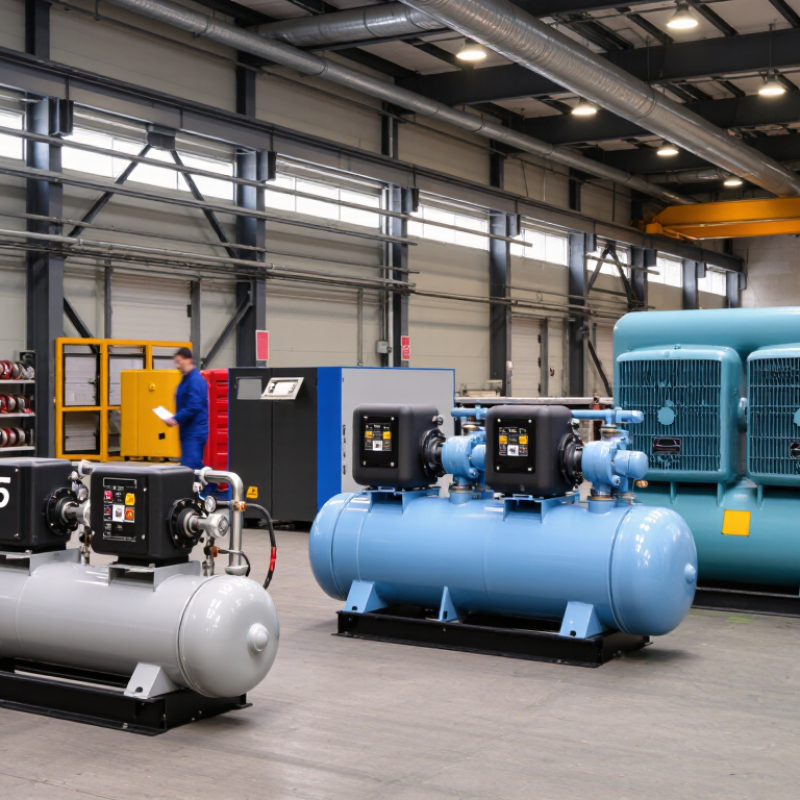
Industrial Air Compressor Types and Their Core Applications
Top 10 Industrial Air Compressors for Global Buyers
Industrial Air Compressor Types and Their Core Applications
Reciprocating compressors suit workshops, service stations, and intermittent production. They deliver strong starting pressure from a compact frame. Their piston movement creates noticeable noise and vibration. A 7.5 kW unit may support pneumatic tools, small assembly lines, and maintenance tasks.
Rotary screw compressors fit factories with steady air demand. They provide continuous flow for packaging, machining, textiles, and automated assembly. Oil-injected models offer efficient operation at common industrial pressures. Oil-free models protect sensitive processes, including food packaging, electronics, and pharmaceutical production. Air quality matters here. ISO 8573-1 classification should guide filter and dryer selection.
Centrifugal compressors serve large facilities requiring high, stable airflow. Typical users include steel plants, chemical processing sites, and large utility systems. They need skilled commissioning and stable operating conditions. Scroll compressors produce clean, quiet air for laboratories and light manufacturing. They are less suitable for heavy, constant loads.
Buyers should match compressor type with duty cycle, not only motor power. Check pressure at the point of use, pipe losses, ambient temperature, voltage, and altitude. In real installations, undersized dryers and narrow piping often cause avoidable pressure drops. That mistake is easy to repeat. A site survey can reveal fluctuating demand, leaks, and poor drainage before equipment selection. Maintenance access also deserves attention. A low purchase price may become expensive when filters, belts, or service labor are difficult to source locally.
Top 10 Industrial Air Compressors for Global Buyers
Industrial Air Compressor Types and Their Core Applications
The chart compares representative typical discharge pressures for widely used industrial compressor types. Selection depends on required airflow, pressure stability, air purity, duty cycle, energy efficiency, and the operating environment. Values are representative industry ranges rather than manufacturer-specific ratings.
Key Performance Specifications for Comparing Global Models
Top 10 Industrial Air Compressors for Global Buyers
Comparing global air compressors requires more than reading horsepower ratings. Start with free air delivery, measured at a stated pressure and temperature. A model producing 10 m³/min at 7 bar may deliver less at 10 bar. Check the test standard, not only the headline figure. Working pressure should match the tools, valves, and production line. Extra pressure can increase energy use unnecessarily.
Motor efficiency, duty cycle, and cooling design also deserve close attention. In a hot factory, poor ventilation may reduce output or trigger thermal shutdowns. Oil-injected units can suit general manufacturing, while oil-free designs may support sensitive processes. Confirm air purity classes and filtration stages with an engineer. Noise matters too, especially near operators. I once focused too heavily on rated power and underestimated maintenance access. That was a costly lesson.
Tips: Compare specific power, expressed as kW per m³/min, across similar pressure points. Review voltage, frequency, altitude limits, and ambient temperature before ordering. Ask for service intervals, spare-part availability, and controller functions. A clear maintenance plan often matters more than a small efficiency advantage. Consider receiver size carefully; an oversized tank occupies space, while a small one may cause frequent cycling. Real operating data is useful, but it can be incomplete. Leave room for that uncertainty.
Top 10 Industrial Air Compressors for Global Buyers - Key Performance Specifications for Comparing Global Models
| Rank | Reference Configuration | Compressor Type | Rated Motor Power | Free Air Delivery (FAD) | Rated Working Pressure | Maximum Pressure | Drive System | Cooling Method | Noise Level | Approx. Dimensions
(L × W × H) | Approx. Weight | Typical Industrial Applications |
| 1 | Heavy-Duty Variable-Speed Screw, 75 kW | Oil-injected rotary screw | 75 kW / 100 hp | 12.8 m³/min at 7 bar | 7 bar(g) | 10 bar(g) | Direct drive with variable-frequency control | Air-cooled | 72 dB(A) | 2,150 × 1,250 × 1,900 mm | 1,650 kg | General manufacturing, automotive assembly, metal fabrication |
| 2 | Industrial Variable-Speed Screw, 55 kW | Oil-injected rotary screw | 55 kW / 75 hp | 9.4 m³/min at 8 bar | 8 bar(g) | 13 bar(g) | Direct drive with variable-frequency control | Air-cooled | 70 dB(A) | 2,000 × 1,150 × 1,780 mm | 1,280 kg | Packaging, electronics production, machine tools |
| 3 | High-Pressure Fixed-Speed Screw, 110 kW | Oil-injected rotary screw | 110 kW / 150 hp | 17.6 m³/min at 10 bar | 10 bar(g) | 13 bar(g) | Gear-driven fixed-speed motor | Air-cooled | 76 dB(A) | 2,850 × 1,650 × 2,050 mm | 2,850 kg | Continuous process air, textile plants, large workshops |
| 4 | Oil-Free Screw, 90 kW | Oil-free two-stage rotary screw | 90 kW / 120 hp | 14.2 m³/min at 7 bar | 7 bar(g) | 10 bar(g) | Direct drive fixed-speed motor | Water-cooled | 74 dB(A) | 2,700 × 1,600 × 2,100 mm | 3,100 kg | Food and beverage, pharmaceutical, medical and clean-process air |
| 5 | Compact Variable-Speed Screw, 30 kW | Oil-injected rotary screw | 30 kW / 40 hp | 5.1 m³/min at 7.5 bar | 7.5 bar(g) | 10 bar(g) | Direct drive with variable-frequency control | Air-cooled | 67 dB(A) | 1,800 × 950 × 1,550 mm | 720 kg | Small factories, CNC machinery, assembly lines |
| 6 | Oil-Free Scroll, 22 kW | Oil-free scroll | 22 kW / 30 hp | 2.35 m³/min at 8 bar | 8 bar(g) | 10 bar(g) | Multiple scroll modules with staged control | Air-cooled | 60 dB(A) | 1,450 × 900 × 1,650 mm | 560 kg | Laboratories, dental facilities, electronics and light cleanroom use |
| 7 | Reciprocating Piston, 15 kW | Two-stage reciprocating piston | 15 kW / 20 hp | 1.65 m³/min at 8 bar | 8 bar(g) | 12 bar(g) | Belt-driven fixed-speed motor | Air-cooled | 78 dB(A) | 1,650 × 850 × 1,450 mm | 430 kg | Maintenance shops, intermittent pneumatic tools, repair garages |
| 8 | Oil-Free Reciprocating, 7.5 kW | Oil-free reciprocating piston | 7.5 kW / 10 hp | 0.78 m³/min at 7 bar | 7 bar(g) | 10 bar(g) | Belt-driven fixed-speed motor | Air-cooled | 75 dB(A) | 1,250 × 700 × 1,200 mm | 220 kg | Dental air, instrumentation, laboratories and light-duty production |
| 9 | Low-Pressure Rotary Lobe, 45 kW | Positive-displacement rotary lobe blower | 45 kW / 60 hp | 28.0 m³/min at 0.8 bar | 0.8 bar(g) | 1.0 bar(g) | Belt-driven fixed-speed motor with acoustic enclosure | Air-cooled | 80 dB(A) | 2,300 × 1,350 × 1,750 mm | 1,450 kg | Wastewater aeration, pneumatic conveying, bulk-material handling |
| 10 | High-Pressure Booster, 37 kW | Reciprocating booster compressor | 37 kW / 50 hp | 1.05 m³/min at 30 bar | 30 bar(g) | 40 bar(g) | Two-stage piston booster | Air-cooled | 82 dB(A) | 1,900 × 1,050 × 1,650 mm | 890 kg | PET bottle blowing, pressure testing, gas-cylinder filling |
Note: Performance figures are representative reference specifications for comparing common industrial compressor configurations. Actual FAD, dimensions, weight, noise and energy performance vary with pressure, altitude, cooling conditions, control settings and regional electrical standards.
Top 10 Industrial Air Compressors by Capacity and Use Case
Top 10 Industrial Air Compressors by Capacity and Use Case
Capacity should follow demand, pressure, air quality, and duty cycle. A compact reciprocating compressor below 0.5 m³/min suits intermittent tools and maintenance benches. Scroll units from 0.5 to 2 m³/min support laboratories, electronics, and quiet assembly areas. Rotary screw compressors between 1 and 5 m³/min fit workshops with steady pneumatic demand. Variable-speed screw models from 3 to 10 m³/min work well for packaging lines with changing shifts.
Oil-free screw compressors around 5 to 20 m³/min serve food, beverage, and pharmaceutical processes. Two-stage screw systems from 10 to 30 m³/min support machining cells and continuous production. Oil-flooded systems from 20 to 60 m³/min suit general plant air.
Centrifugal compressors from 60 to 150 m³/min match large process facilities. Multi-stage centrifugal systems from 150 to 300 m³/min serve steel, chemical, and utility operations. Above 300 m³/min, parallel compressor trains provide stronger production resilience.
The U.S. Department of Energy’s Compressed Air Sourcebook reports that leaks can waste 20–30% of generated air. DOE guidance also identifies compressed air as potentially consuming 10% or more of industrial electricity.
Therefore, a larger compressor is not automatically safer. Oversizing may increase unloaded running, heat, and maintenance costs. ISO 8573-1 should guide oil, particle, and moisture requirements, especially for sensitive production.
These ranges are practical, not absolute. I would verify actual flow using logged demand, not a single nameplate value. A capacity chart can mislead. Receiver volume, pressure drops, ambient temperature, and future expansion still require site testing before purchase.
Energy Efficiency, Maintenance, and Total Ownership Costs
Top 10 Industrial Air Compressors for Global Buyers
Energy efficiency should lead every compressor comparison. The U.S. Department of Energy reports that compressed air can consume 10% or more of industrial electricity. Its guidance also estimates that leaks may waste 20–30% of compressor output. In a busy factory, that loss sounds like a soft hiss beside a loading bay, but it can run continuously.
Buyers should compare specific power, measured in kilowatts per cubic metre per minute, rather than motor size alone. Variable-speed control can reduce unloaded running, although savings depend on demand patterns. Oversizing remains a common and expensive mistake.
Maintenance affects both output and ownership cost. The DOE recommends regular leak surveys, pressure checks, filter servicing, and compressor sequencing reviews. These tasks are simple, but they are often postponed during production peaks.
A blocked filter can increase pressure drop, forcing the compressor to work harder. Keep records. They expose gradual performance decline.
Total ownership cost includes electricity, dryers, filters, oil, labour, downtime, and disposal. The Carbon Trust’s compressed-air guidance similarly stresses that energy usually dominates lifetime expense.
Local electricity prices, humidity, altitude, and service availability can change the ranking between models. Ask for independently verified performance data, including full-load and part-load figures. Marketing tables are not enough.
I would also test the site’s real demand before choosing capacity; estimates can be wrong by a surprising margin. A cheaper machine may become costly after only a few years.