
+1 877-337-9312 | sale@sflbuild.com

Blog

Top Coil Transfer Cart Manufacturers for Global Buyers

Global demand for steel-handling equipment reflects the scale of the industry it serves. World Steel Association’s World Steel in Figures 2024 reports that global crude steel production reached 1,892.2 million tonnes in 2023. That volume moves through mills, service centers, ports, and fabrication plants. At many sites, heavy coils travel across busy floors, where a poorly matched transfer system can slow work and complicate handling.

A Coil Transfer Cart is designed to move steel coils between production or storage points. Yet “coil cart” does not describe one universal specification. Buyers need to compare rated load, coil dimensions, transfer distance, floor condition, steering, power supply, and control options. The International Energy Agency’s Iron and Steel Technology Roadmap (2020) also highlights the sector’s substantial energy and emissions footprint. It makes operating efficiency worth considering, though a cart’s actual energy use depends on its design and duty cycle.

This guide introduces manufacturers serving global buyers and the questions that help separate a suitable solution from a polished brochure. Ask for load calculations, layout drawings, safety features, maintenance guidance, and commissioning support. Check whether the proposed cart fits the aisle width and floor joints at your site. Small details matter.

A catalog cannot prove performance on your floor. Manufacturer claims need verification against operating conditions, references, and documented specifications. That comparison is useful, but not complete; service access and spare-parts availability can be harder to judge from a distance. Still, careful evaluation gives buyers a firmer basis for selecting equipment that fits their coil-handling needs.
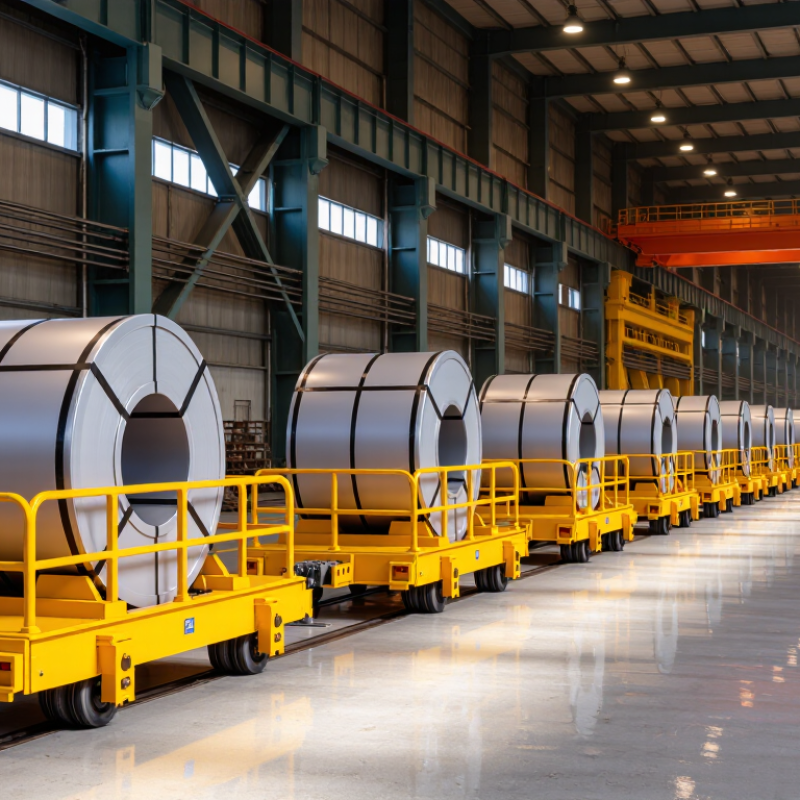
Top Coil Transfer Cart Manufacturers for Global Buyers

Understanding Coil Transfer Carts and Their Industrial Applications

Coil transfer carts move heavy steel or aluminum coils between production stations, storage areas, and loading zones.

Their low platforms support loads that forklifts may handle less steadily. A V-shaped cradle helps keep a coil from rolling, while padded contact points can protect finished surfaces. Some carts travel on floor rails; others use powered wheels for flexible routes.

Keep the path clear.

In steel mills, carts can carry hot-rolled coils from processing lines to temporary storage. In stamping plants, they may deliver cold-rolled coils close to press equipment. Warehouses use them to reposition coils without repeated crane lifts.

The right setup depends on coil weight, width, core diameter, floor condition, and turning space.

Operators should confirm the load’s center of gravity and test braking under realistic conditions. A cart rated for the weight may still perform poorly on uneven floors.

That detail is easy to overlook.

Routes, controls, and loading methods should be reviewed with the people who use the equipment daily.

How to Evaluate Coil Transfer Cart Manufacturers

Evaluating coil transfer cart manufacturers starts with the load, not the catalogue. Share the coil’s maximum weight, width, inner and outer diameters, and lifting method. Ask how the supplier accounts for an off-centre load and repeated starts. A cart rated only for the nominal weight may not suit your real operating cycle. Numbers matter. Request drawings showing wheel loads, turning clearance, braking distance, and the proposed route, including floor joints and gradients.

Check how the cart fits your production system. Rail-guided and battery-powered models have different installation and maintenance needs. Ask for documented load tests, emergency-stop details, duty-cycle limits, and spare-parts lead times. The International Federation of Robotics’ World Robotics 2024 report counted 4,281,585 industrial robots operating worldwide in 2023, 10% more than in 2022. This signals wider industrial automation, but it does not prove a cart will integrate smoothly with your line. Request interface details and a witnessed factory acceptance test. Even a sound design can miss a floor joint or a rushed shift change. That deserves a second look.

Leading Manufacturers Serving the Global Market

Global coil transfer cart manufacturers serve steel mills, service centers, and heavy fabrication plants across different operating conditions. The World Steel Association reported 1.892 billion tonnes of crude steel production in 2023, reflecting the scale of material handling needs. This is industry context, not a direct measure of cart demand. IFR’s World Robotics 2024 report counted 4,281,585 industrial robots operating in factories worldwide in 2023. Its figures point to broader factory automation, while coil-cart requirements remain highly site-specific.

For global buyers, a capable manufacturer should ask about coil mass, width, travel distance, floor joints, and loading frequency before proposing a design. A cart moving a hot coil beside a furnace faces different conditions from one serving a warehouse aisle. Buyers should review rated capacity, braking behavior, controls, maintenance access, and documentation, then confirm that the proposed layout fits their facility. Small details matter. A poorly placed charging point can interrupt a shift; uneven flooring can affect travel and stopping. Remote commissioning and spare-parts support are useful, but their response times should be agreed in writing. Specifications can look complete on paper. They still need checking against real operating conditions.

Top Coil Transfer Cart Manufacturers for Global Buyers – Leading Manufacturers Serving the Global Market

Evaluation Dimension Common Design or Procurement Data What Global Buyers Should Verify
Rated load and coil range Specify the maximum coil mass, minimum and maximum coil diameter, coil width, and any load-handling attachment mass. Capacity is a project-specific design value. Check that the rated capacity covers the coil and tooling together, and request the proposed load distribution and operating limits.
Coil support and retention Coil carts commonly use a V-shaped saddle or other shaped support to locate round coils. Support geometry depends on coil dimensions and handling orientation. Confirm saddle angle, contact surface, coil-centering method, and whether restraints are needed for travel, stopping, or uneven floors.
Travel path and guidance Transfer carts may be rail-guided or designed for floor travel. Rail layout, route length, curves, crossings, and stopping locations affect the design. Provide a dimensioned site layout and verify route compatibility, clearances, stopping accuracy, and the required floor or rail capacity.
Power supply Available configurations can include battery power, cable-reel power, or conductor-rail power. Each has different infrastructure and operating requirements. Confirm site voltage and frequency, charging or cable arrangements, duty cycle, travel distance, and the safe routing of power equipment.
Drive, speed, and duty cycle Drive configuration and operating speed should be matched to the load, route, starts and stops, and number of operating cycles. Ask for the design duty cycle, acceleration and braking behavior, travel speed under load, and any operating restrictions.
Controls and safety functions Controls may include pendant or remote operation, emergency stops, warning devices, and travel-limit or obstacle-detection features, depending on the design. Review the risk assessment, control-system description, emergency-stop locations, operator visibility, and site-specific safety requirements.
Structural and electrical documentation Relevant references may include ISO 12100 for machinery risk assessment and IEC 60204-1 for electrical equipment of machinery. Applicability depends on the project and jurisdiction. Request drawings, calculations, wiring diagrams, operating instructions, and a list of standards applied to the specific cart.
Welding and quality management ISO 3834 addresses quality requirements for fusion welding of metallic materials; ISO 9001 specifies requirements for quality management systems. Check the scope and validity of any certificates, whether they cover the relevant facility and work, and what inspections and records are supplied.
Export and site acceptance Shipping, installation, commissioning, documentation, and conformity obligations vary by destination and project scope. Agree on delivery terms, installation responsibilities, local conformity requirements, acceptance tests, training, spare parts, and after-sales support before order placement.

Buyer note: Specifications and compliance obligations are project- and jurisdiction-dependent. Request evidence for the exact proposed design rather than assuming that a feature or certification applies to every manufacturer or cart.

Comparing Cart Designs, Safety Systems, and Customization Options

Coil transfer carts differ most at the load interface. A V-shaped deck can cradle a coil, while a saddle or turntable may suit different coil widths and unloading angles. Buyers should compare rated capacity, coil diameter, aisle width, floor condition, and transfer distance—not just the headline payload. Small details matter. A low deck may ease loading, but it can reduce ground clearance on uneven floors. Powered carts can help on long routes; manual designs may fit short, level moves. Neither is automatically safer.

Safety features should match the actual route and handling steps. Look for load restraints, wheel brakes, emergency stops, audible alerts, and clear operator sightlines. BLS recorded 5,283 fatal work injuries in the United States in 2023, across all industries; that figure is not specific to coil carts, but it underscores why workplace risk deserves careful review. The MHI 2024 Annual Industry Report found that 55% of surveyed companies planned to increase supply-chain technology investment. That trend makes powered controls and sensors worth evaluating, not purchasing blindly. Ask suppliers to explain how each feature works under load, during a stop, and after a sensor fault.

Customization should start with measured coils and a real route map. Specify coil eye orientation, maximum width, floor joints, turning points, and charging access. Request drawings and a load test plan. One weak spot in many comparisons is relying on a clean factory layout. A tight corner or rough seam can change the choice. No drawing catches every snag.

Assessing International Sourcing, Compliance, and After-Sales Support

For global buyers, a coil transfer cart is not just a load rating on a quotation. Check coil width, maximum weight, aisle clearance, floor condition, and loading method against the actual plant layout. Request drawings, test records, component specifications, and a clear list of what the price includes. UNCTAD’s Review of Maritime Transport 2024 reported that maritime trade grew 2.4% in 2023 and projected continued growth. That matters: shipping schedules and landed costs can shift, so confirm packaging, delivery terms, spare-parts availability, and lead times in writing. Small details matter.

Compliance needs destination-specific review. Ask the supplier to identify applicable electrical, machinery-safety, and documentation requirements, then have a qualified local reviewer verify them before shipment. A certificate alone may not cover the complete installed system. The World Bank’s 2023 Logistics Performance Index assessed 139 countries and tracks factors including shipment timeliness and logistics competence. Use those indicators as context, not as a guarantee of delivery. After-sales support deserves equal scrutiny: confirm response hours, remote diagnostics, training materials, warranty exclusions, and replacement-part routes. A useful test is to ask how a technician would troubleshoot a cart that stops under load. If the answer is vague, that is worth reflecting on. Even a strong factory audit cannot predict every floor-level problem.