+1 877-337-9312 | sale@sflbuild.com

Blog

How to Choose the Right Acoustic Panels for Your Space?

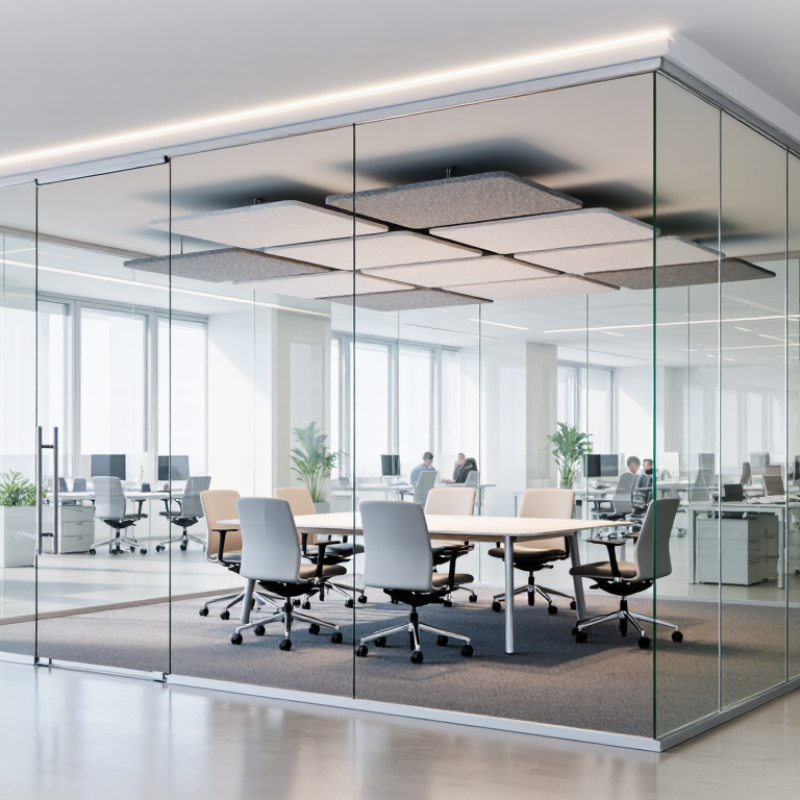
A room can look quiet and still feel tiring. In a glass meeting room, voices bounce between hard walls, making speech harder to follow. Acoustic Panels can reduce reflections, but the right choice depends on the room, its use, and the problem you want to solve. A panel’s appearance alone tells you little.

Professional standards offer useful reference points. ANSI/ASA S12.60 sets classroom criteria that include a maximum reverberation time of 0.6 seconds for certain smaller learning spaces. That figure is not a universal target for offices, restaurants, or homes. It does show why room volume and intended use matter. Reverberation time describes how long sound continues after its source stops; it is not the same as blocking noise from a neighboring room. That distinction is easy to miss.

A practical selection starts with listening: are conversations echoing, does speech feel unclear, or is outside noise intruding? Then consider panel absorption ratings, coverage, placement, ceiling height, and surface materials. ASTM C423 is a recognized method for measuring sound absorption, while product ratings should be checked against the test conditions and frequency data. More panels do not automatically mean a better room. Sometimes the real issue is the layout, an untreated ceiling, or sound leaking through a door. This guide explores how to match panel performance and placement to your space, while treating published ratings as evidence—not promises.
How to Choose the Right Acoustic Panels for Your Space?

Define the Room’s Acoustic Goal Using Applicable RT60 Benchmarks

Before choosing acoustic panels, decide what the room must support: clear speech, music, or quiet concentration. RT60 is the time sound takes to decay by 60 dB after the source stops. ANSI/ASA S12.60-2010/Part 1 sets unoccupied classroom limits of 0.6 seconds for rooms up to 10,000 cubic feet, and 0.7 seconds for rooms between 10,000 and 20,000 cubic feet. These are classroom criteria, not universal targets for every home office or café. Measure before buying.

For broader planning, DIN 18041:2016 offers room-acoustic guidance based on room use, including speech-focused spaces. Record RT60 at several listening positions, with doors and furnishings in their usual state. A bare meeting room with glass walls may ring longer than a carpeted room of similar size. Compare measurements with a relevant use-based benchmark, then estimate the absorption needed. Panel coverage, ceiling height, and placement all affect results. A few decorative panels may change the sound without meeting the target. Phone apps can flag a problem, but calibrated measurement is more dependable. Recheck after installation.

Measure Room Volume and Estimate Reverberation Time with Sabine’s Formula

How to Choose the Right Acoustic Panels for Your Space?

Measure the room’s length, width, and height in meters, then multiply them to find its volume. A room measuring 5 by 4 by 2.8 meters contains 56 cubic meters. Sabine’s formula estimates reverberation time: RT60 = 0.161 × room volume ÷ total absorption. RT60 is the time sound takes to fade by 60 decibels. Total absorption, measured in sabins, includes contributions from surfaces, furniture, and people. A bare room with hard walls and a tile floor usually has less absorption than a furnished room with curtains and a rug.

Tips: Estimate existing absorption before buying panels. Check the product’s absorption data at several frequencies, not just one overall rating. Keep your measurements handy.

Use the estimate to decide whether your room needs a shorter reverberation time. A lively meeting room may benefit from panels on reflective walls or the ceiling. Avoid covering every surface automatically; too much absorption can make a room feel unnaturally dull. Sabine’s formula is a useful starting point, not a promise. Irregular layouts, open doorways, and uneven panel placement can affect the result. I’d treat the calculation as a guide, then listen from different seats and adjust where echoes remain.

Compare Absorption Ratings: NRC per ASTM C423 and αw per ISO 11654

When comparing acoustic panels, check how each absorption rating was measured. NRC, determined under ASTM C423, averages absorption coefficients at 250, 500, 1,000, and 2,000 Hz. The result is rounded to the nearest 0.05. It offers a quick comparison, not a complete picture. A high NRC does not tell you exactly how a panel handles bass.

The αw rating follows ISO 11654. It compares measured absorption across octave bands with a reference curve and reports a weighted value, often alongside an absorption class. Look beyond the headline number. A meeting room with sharp speech echoes may benefit from strong mid-frequency absorption, while a music room may need attention to lower frequencies too. Different ratings are not directly interchangeable.

Check the test report for panel thickness, mounting method, and any air gap behind the sample. These details affect results. A panel tested with space behind it may perform differently when fixed flat to a wall. In practice, placement matters as well: a few panels near a reflective desk area can make conversation clearer, but they may not solve every echo. I’d compare the test conditions carefully; product data can still leave questions.

Match Panel Thickness and Air Gap to the Frequencies You Need to Absorb

Panel thickness and the air gap behind it work as one absorber. A 50-millimeter panel mounted directly on drywall mainly helps with mid and high frequencies. Add a 50-millimeter gap, and the effective absorber depth increases, often improving lower-frequency absorption. The change is useful, not magical. At 125 Hz, sound has a wavelength of about 2.7 meters, based on a sound speed of 343 meters per second. A thin panel cannot reliably tame deep bass on its own.

Choose based on the problem you hear. For sharp reflections from speech or clattering dishes, a thinner panel may be adequate. For a boomy meeting room, use thicker porous material or mount it with a generous gap; treat corners too. I still find this easy to misjudge by eye. Measure before buying. ASTM C423 describes laboratory testing of sound-absorbing materials, while the commonly used Noise Reduction Coefficient averages absorption at 250, 500, 1,000, and 2,000 Hz, then rounds to the nearest 0.05. That single number can hide weak bass performance. Ask for octave-band absorption data, especially at 125 and 250 Hz, and check the tested mounting condition. A panel tested with an air gap may perform differently when installed flush against a wall.

How to Choose the Right Acoustic Panels for Your Space? — Match Panel Thickness and Air Gap to the Frequencies You Need to Absorb

Panel Thickness Recommended Air Gap Practical Frequency Focus Typical Applications Selection Notes
1 in (25 mm) Flush-mounted or 1–2 in (25–50 mm) Primarily high frequencies and some upper midrange, roughly 1,000 Hz and above Reducing flutter echo and excess brightness in offices, classrooms, and small meeting rooms Best for limited wall depth. It is generally less effective at controlling low-frequency buildup.
2 in (50 mm) Flush-mounted or 2 in (50 mm) Mid and high frequencies; performance generally improves as the air gap increases Speech-focused rooms, home offices, podcast spaces, and general-purpose wall treatment A practical starting point for broadband absorption when deep bass control is not the main goal.
3 in (75 mm) 2–3 in (50–75 mm) Broader midrange absorption, with better lower-midrange response than thinner panels Listening rooms, rehearsal rooms, and spaces with noticeable room coloration Useful when both speech clarity and some reduction of lower-midrange reflections are desired.
4 in (100 mm) 2–4 in (50–100 mm) Broadband midrange and upper bass; results depend on material, mounting, and room conditions Control rooms, music rooms, and rooms with persistent low-mid buildup A thicker panel and air gap can extend useful absorption lower than a thin, flush-mounted panel, but will not guarantee deep-bass control.
6 in (150 mm) or more 4–6 in (100–150 mm), where space allows More useful for lower-frequency absorption than thinner panels; deep bass may still require specialized treatment Recording rooms, dedicated listening rooms, and spaces where low-frequency ringing is a concern Consider corner placement and room measurements. For strong bass problems, purpose-designed bass traps may be more appropriate.

Important: Frequency ranges are practical guidance, not guaranteed cutoffs. Absorption varies with the panel’s material, airflow resistance, density, mounting method, and the room itself. An air gap can improve low-frequency performance by positioning the absorber farther from the wall, but panel thickness and gap are not interchangeable in every design. Check tested absorption data for the specific panel before making a final choice.

Plan Panel Coverage and Check Test Data Measured Under ISO 354

Plan panel coverage around the room’s reverberation problem, not wall area alone. Hard floors, glass, and bare ceilings can keep speech bouncing long after a sentence ends. Estimate the room’s volume and existing absorption, then set a realistic reverberation-time target. ANSI/ASA S12.60-2010/Part 1 (R2020), for example, specifies a maximum reverberation time of 0.6 seconds for unoccupied core learning spaces up to 10,000 cubic feet. That is a classroom criterion, not a universal target for every room.

Check the test data before comparing panels. ISO 354:2003 measures sound absorption in a reverberation room, and results are reported by frequency. Look for the tested frequencies and mounting method; a panel tested with an air gap may perform differently when fixed directly to a wall. A single rating can hide weak low-frequency performance. Small details matter. Place absorption where reflections are strong, such as a hard wall opposite a speaking area, but avoid assuming that more coverage always solves the problem. Even a careful estimate can miss furnishings, occupancy, or unusual room geometry. That uncertainty is worth acknowledging before ordering.

How to Choose the Right Acoustic Panels for Your Space?

Plan Panel Coverage and Check Test Data Measured Under ISO 354

Coverage is calculated as panel area divided by a 100 m² ceiling area. These figures are planning examples, not predicted acoustic results. Compare products using ISO 354 test data, especially absorption values across relevant frequency bands; performance depends on the panel and its installation.