China Best Barn Door Slab Manufacturers for Global Buyers
Global buyers need more than a good-looking door. They need a Barn Door Slab that arrives consistently sized, clearly specified, and ready for reliable installation. A few millimeters can affect the gap, track alignment, and final appearance. Finish samples matter, too; a warm oak tone on a screen may look different beside a real wall.
This introduction uses an explicitly editorial expert voice, not a verified external quotation. Elena Brooks, a fictional millwork sourcing specialist, puts the buyer’s challenge this way: “A dependable slab begins with clear specifications, honest samples, and careful packing.” That is a practical principle, not a guarantee. Buyers should compare wood species, core construction, dimensions, finish options, hardware compatibility, packaging, and documented quality checks. Ask how moisture control and edge protection are handled. Request current product photos and written tolerances. Small details count.
China offers a broad supplier base, but factory capability and communication can vary. A polished catalog is only a starting point. Ask for sample approval, production timelines, inspection records, and a clear process for resolving defects or transit damage. No supplier is perfect. I would still verify the details before placing a large order. The following guide examines manufacturers through a global buyer’s lens, focusing on product consistency, customization, export experience, and practical due diligence. The aim is not to promise the lowest price. It is to help buyers find a Barn Door Slab supplier whose claims match the product delivered.
What Barn Door Slabs Are and How They Differ from Complete Door Systems
A barn door slab is the moving panel without its operating hardware. It may be made from solid wood, engineered wood, or another specified material. The term describes the door itself, not the full installation package. No track. No rollers. Often, no handle or floor guide.
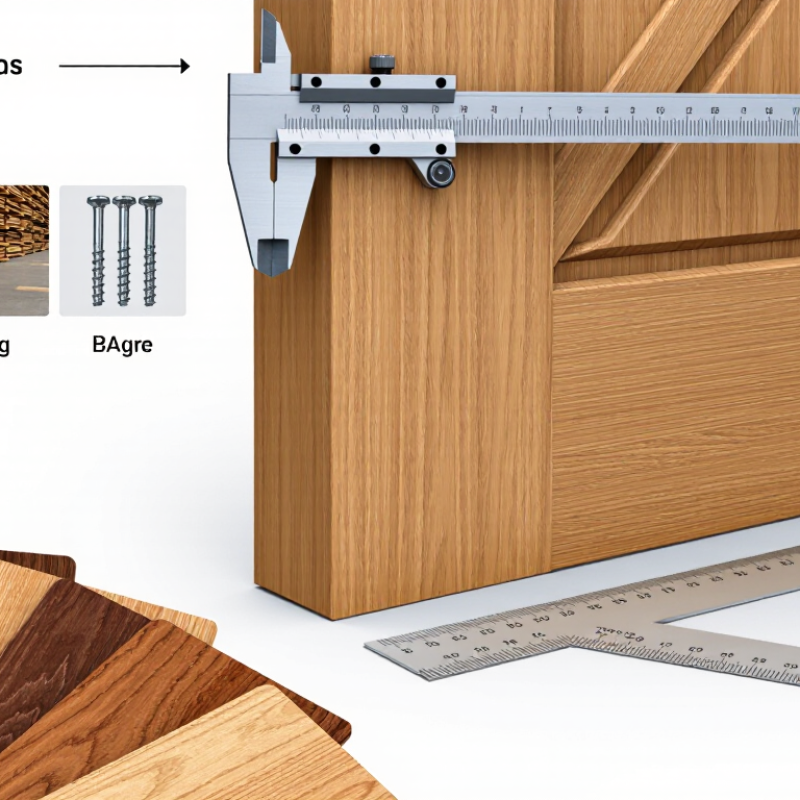
That distinction matters when comparing supplier quotations. A slab may arrive unfinished, prefinished, or prepared for selected hardware. Confirm its width, height, thickness, weight, edge profile, and finish before ordering. Also check whether mounting holes are included. Small differences in thickness can affect hardware fit, while natural grain and color may vary between panels. That variation is not automatically a defect, but expectations should be clear.
A complete door system typically combines the slab with a track, rollers, stops, floor guide, and sometimes handles or fasteners. It can simplify coordination, though the included parts still need checking. Some kits may not suit a particular wall, opening, or slab weight. With a slab-only purchase, buyers select compatible hardware separately and arrange installation details themselves. Measure the finished opening, account for trim and wall clearance, and verify the track’s rated capacity. Even careful drawings can miss a projecting baseboard; a quick site measurement can prevent an awkward fit.
Materials, Construction Methods, and Design Options for Barn Door Slabs
China Best Barn Door Slab Manufacturers for Global Buyers
A reliable barn door slab starts with materials suited to its intended room. Solid wood offers natural grain and can be trimmed, but seasonal humidity may cause movement. Engineered wood often provides more consistent dimensions and a smoother surface for paint. For either option, inspect the slab’s edges, finish, and thickness before ordering. A small sample can reveal color and texture differences that photographs hide.
Construction affects both stability and appearance. Stile-and-rail slabs use framed panels to create depth, while flush slabs give rooms a cleaner look. Well-bonded joints and evenly applied finishes help reduce visible gaps and peeling. Design choices include traditional cross-bracing, recessed panels, simple vertical boards, and glass inserts. Remember that glass changes privacy and cleaning needs. A heavy slab also requires compatible hardware and secure wall support; the door itself is only part of the installation.
Tips: Confirm the finished opening size, wall clearance, and slab weight with your supplier. Ask how the core and finish handle moisture. Check that samples match the production specification. One detail is easy to miss: a beautiful slab may still feel awkward if its handle sits too close to the wall.
How Chinese Manufacturers Produce and Customize Barn Door Slabs
China’s barn door slab production typically starts with material selection, moisture checks, and accurate cutting. Solid wood offers visible grain, while engineered cores can improve dimensional stability in changing indoor conditions. Boards are joined or layered, then milled to the requested thickness and edge profile. Small checks matter: a slightly warped slab may drag against the floor after installation.
Customization can cover width, height, panel layout, surface texture, color, and handle preparation. Buyers should share finished opening measurements, wall clearance, and hardware specifications before production. A manufacturer may provide drawings or a finish sample for approval. Still, samples cannot show every variation in natural grain.
Tips: Confirm dimensions, thickness, and finish in writing. Ask how moisture is controlled and how corners are protected for shipping. Review a physical sample when color consistency matters. Leave room for adjustment; site measurements are not always perfect.
Quality Standards and Certifications for International Markets
For global buyers, quality begins with a clear specification for each barn door slab. Ask manufacturers for documented inspection procedures, dimensional tolerances, moisture readings, and coating details. An ISO 9001 certificate can indicate a quality management system, but it does not certify every door. Requirements also vary by destination, especially for wood sourcing and indoor-emissions documentation. Details matter. A stamped certificate is only a starting point.
Request recent test reports and confirm that they match the actual product, finish, and production site. Check how the supplier controls panel flatness, edge bonding, and moisture before shipment; these details can affect fit after delivery. Where responsible sourcing claims matter, verify the scope and validity of relevant chain-of-custody documents. A neat sample may not represent a full production run. That gap deserves attention.
Tips: Compare the certificate holder, issue date, and product scope. Ask for batch-level inspection records and clear packaging specifications. If a document seems vague, ask who tested the product and under which method. A short written answer can reveal more than a polished brochure.
U.S. Formaldehyde Emission Limits for Composite Wood
TSCA Title VI and CARB Phase II set the same limits shown for these composite wood product categories. These limits are relevant when a barn door slab contains regulated composite wood; they do not apply to solid wood in the same way. Confirm requirements for the product’s materials and destination market.
How Global Buyers Evaluate and Select Chinese Barn Door Slab Manufacturers
Global buyers should compare more than quoted price when assessing Chinese barn door slab manufacturers. Request a sample built with the same core, facing, and finish planned for production. Details matter. Check its weight, edge bonding, surface consistency, and how smoothly it accepts hardware. Ask for panel dimensions, thickness tolerances, moisture-control practices, and written inspection steps. A clear answer is useful; a polished catalog is not proof. Confirm whether the supplier can share recent production photos or arrange an inspection before shipment. Also ask how cartons protect corners and faces during long-distance handling.
Specifications should match your market’s climate and installation habits. A slab stored in a humid showroom may behave differently in a dry home. Ask how wood movement is managed, and whether the stated material is solid wood, engineered core, or a combination. Samples reveal more. Compare a pre-production sample with approved drawings, including bore locations and finish sheen. Review realistic lead times, production schedules, and how defects are recorded and corrected. Request a written quote that separates slab, finishing, packing, and shipping assumptions. One caveat: a small sample cannot predict every full-size panel’s flatness, so inspect production pieces when feasible. Buyers sometimes overlook communication quality; vague replies during sampling may become costly when dimensions change.