
Blog
What Is the Best Acoustic Board Supplier in China?
Choosing the best acoustic board supplier in China requires more than comparing catalog prices. The right partner should understand how sound behaves in offices, studios, schools, hotels, and public interiors. Acoustic performance depends on the room, not only on the panel.
Sound consultant Julian Treasure has said, “We are all affected by sound.” This simple observation matters during supplier evaluation. A reliable manufacturer should provide clear test data, including sound absorption ratings, fire performance, formaldehyde information, density, and panel durability. Ask whether testing was completed by an independent laboratory. Ask for current reports, not attractive claims printed on a brochure.
Factory experience also deserves close attention. Check production capacity, raw material consistency, edge finishing, color accuracy, packaging, and quality inspection procedures. A capable acoustic board supplier should explain how panels perform after installation. Samples should show more than texture. They should reveal thickness, backing structure, cutting precision, and surface resilience.
Real projects often expose details that product pages ignore. A panel may look excellent in a showroom but fail to suit humid conditions or heavy commercial use. No supplier is perfect. That is worth admitting. The better question is whether the supplier responds honestly when specifications change.
Review completed projects, installation guidance, lead times, customization options, and after-sales support. A dependable Chinese supplier communicates clearly and documents each stage. The best choice is not always the cheapest factory. It is the manufacturer that combines tested acoustic board performance, practical experience, transparent evidence, and consistent delivery. Small details matter. Even the carton can tell you something.
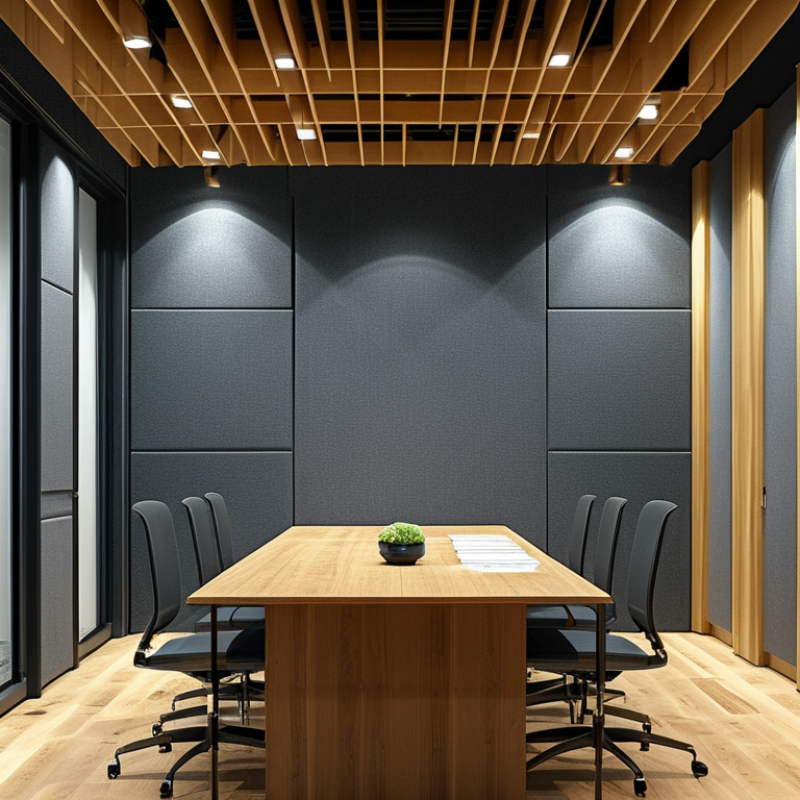
What Defines a High-Quality Acoustic Board Supplier in China?
A high-quality acoustic board supplier in China should offer more than attractive factory photos and low quotations. Reliable suppliers explain how their boards are made, tested, and matched to different spaces. Ask for current data on sound absorption, density, thickness, fire performance, and formaldehyde emissions. Independent laboratory reports are more useful than vague claims. Clear evidence matters.
Practical experience also appears in small details. A capable supplier can recommend board thickness for meeting rooms, studios, restaurants, or open offices. They should discuss reverberation, wall coverage, ceiling height, and installation gaps. Request a physical sample. Check its edge finish, color consistency, surface strength, and odor after unpacking. A good supplier also provides drawings, packing details, production updates, and traceable quality records.
Communication reveals a great deal. Questions should receive technical answers, not copied sales language. Production timelines must include inspection and shipping risks. No supplier gets every detail right. That is worth admitting. In one project, a beautiful panel performed poorly because the room had too little coverage. The mistake was not the board alone; the acoustic plan was incomplete. A dependable supplier welcomes testing, explains limitations, and adjusts recommendations when site conditions change. Their after-sales support should remain available when installers face uneven walls, damaged cartons, or unclear fixing methods. Small omissions can become expensive delays.
| Evaluation Dimension | Key Measurable Indicator | Recommended Benchmark or Reference | Why It Matters | Evidence to Request from the Supplier |
|---|---|---|---|---|
| Sound Absorption | Noise Reduction Coefficient (NRC) | Typically 0.40–0.90 for porous acoustic boards, depending on thickness, density, mounting method, and air gap | A higher NRC generally indicates better average sound absorption across the tested frequency range. | Laboratory test report identifying the exact board thickness, mounting condition, and test configuration |
| Frequency Performance | Sound absorption coefficient by frequency | Performance should be reviewed at 125, 250, 500, 1,000, 2,000, and 4,000 Hz rather than relying only on one rating | Low-frequency absorption can differ significantly from mid- and high-frequency absorption. | Detailed frequency-by-frequency test data, preferably tested according to ISO 354 or ASTM C423 |
| Acoustic Classification | Weighted sound absorption coefficient, αw | ISO 11654 classification ranges from Class A to Class E; Class A represents the highest absorption classification | Provides a standardized way to compare sound-absorbing products. | Classification statement linked to a valid ISO 11654 evaluation and the underlying test report |
| Board Thickness | Nominal and actual thickness | Common acoustic board thicknesses include approximately 9–25 mm; thicker boards generally offer improved low-frequency absorption when properly installed | Thickness affects acoustic performance, rigidity, weight, and installation requirements. | Technical datasheet, dimensional tolerance information, and random incoming inspection records |
| Material Density | Density in kg/m³ | A consistent density within the product specification is more important than using a single universal density value | Density influences sound absorption, mechanical strength, cutting quality, and dimensional stability. | Declared density range, batch inspection records, and a sample verification report |
| Fire Safety | Reaction-to-fire or flame-spread classification | The required class depends on the project and local building code; commonly requested evidence includes EN 13501-1 or ASTM E84 testing | Fire performance is essential for commercial, public, educational, hospitality, and transportation interiors. | Current fire-test report for the exact material, facing, adhesive, coating, and thickness supplied |
| Formaldehyde and VOCs | Formaldehyde emission and volatile organic compound emissions | Low-emission products should be supported by recognized chamber testing; requirements vary by destination market and building standard | Low emissions help support healthier indoor air quality. | Independent emissions test report, safety data sheet, and information about binders, dyes, coatings, and adhesives |
| Dimensional Accuracy | Length, width, thickness, squareness, and flatness tolerance | The supplier should publish tolerances and demonstrate stable results across production batches | Accurate dimensions reduce visible gaps, installation delays, and material waste. | Approved drawings, inspection standards, calibration records, and pre-shipment inspection results |
| Mechanical Durability | Surface strength, flexural resistance, impact resistance, and edge durability | Performance requirements should be matched to the intended application, including wall, ceiling, partition, or freestanding use | Durable boards are less likely to crack, deform, or shed fibers during handling and installation. | Product-specific mechanical test data, handling instructions, and sample approval records |
| Moisture Resistance | Water absorption, humidity exposure, and dimensional change | For humid interiors, verify performance after the environmental exposure required by the project specification | Moisture can affect board dimensions, surface appearance, bonding, and acoustic performance. | Humidity or water-resistance test results and installation limitations for wet or semi-wet areas |
| Surface and Color Quality | Color consistency, texture uniformity, edge finish, and visual defects | A documented visual inspection standard and an approved reference sample should be used for every production batch | Consistent appearance is important for architectural projects with large visible surfaces. | Master sample, color tolerance standard, defect classification, and batch photographs before shipment |
| Customization Capability | Available sizes, shapes, perforations, grooves, printing, cutting, and edge profiles | A capable supplier should provide drawings, prototypes, and production samples before mass manufacturing | Customization allows the acoustic treatment to match room geometry and interior design requirements. | Prototype approval procedure, engineering drawings, sample lead time, and change-control process |
| Quality Management | Raw-material inspection, in-process control, final inspection, and traceability | A documented quality system should identify material batches, production dates, inspection results, and corrective actions | Traceability helps prevent inconsistent performance and simplifies problem resolution. | Quality manual, inspection checklist, batch records, nonconformance procedure, and corrective-action examples |
| Testing Transparency | Validity and completeness of test documentation | Reports should identify the manufacturer, product construction, test date, laboratory, standard, and tested configuration | Generic reports may not represent the exact board being purchased. | Complete third-party reports with product identification and laboratory accreditation details |
| Production Capacity | Monthly capacity, lead time, and peak-season availability | Capacity should be evaluated against the required order volume, delivery schedule, and acceptable production tolerance | A supplier must be able to maintain quality when order quantities increase. | Capacity statement, production schedule, historical lead-time data, and contingency plan |
| Packaging and Export Readiness | Protection against compression, moisture, abrasion, and edge damage | Packaging should be suitable for the board dimensions, stacking method, transport duration, and destination climate | Proper packaging reduces damage during domestic handling and international shipping. | Packaging specification, loading photographs, carton or pallet markings, and damage-claim procedure |
| Installation Support | Adhesive guidance, suspension details, cutting instructions, and maintenance requirements | Installation documentation should state the required substrate, air gap, fixing method, and recommended tools | Incorrect installation can reduce absorption and invalidate laboratory performance expectations. | Installation manual, technical drawings, compatible accessory list, and project support contacts |
| Commercial Reliability | Quotation clarity, sample process, payment terms, response time, and after-sales handling | A reliable supplier provides consistent specifications, written approvals, and a defined process for claims and replacements | Clear communication reduces specification errors, delays, and disputes. | Formal quotation, sales contract, approved specification sheet, warranty terms, and claim-resolution procedure |
Related Posts
-
Unlocking the Secrets of Acoustic Boards: Enhancing Sound Quality in Modern Spaces
-
Why Sound Insulation Panels Are Essential for a Quiet and Comfortable Home
-

Best Sound Insulation Panels for Home Use 2026 Guide?
-
How to Choose the Best Acoustic Board for Your Home Soundproofing Needs?
-
2026 Best Noise Panels for Soundproofing Your Space?
-

Top 10 Acoustic Products to Elevate Your Sound Experience in 2025