What Are the 2026 Top Types of Acoustic Ceiling Panels?
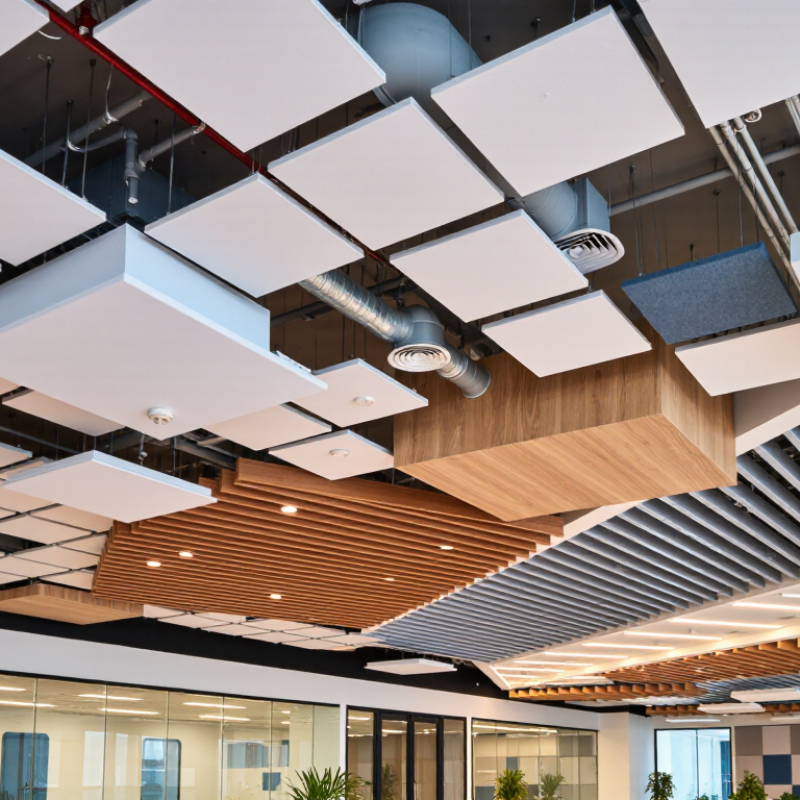
In 2026, the phrase acoustic panels ceiling covers several distinct solutions, not one universal product. Mineral-fiber tiles remain common in offices and classrooms because they fit suspended grids and are easy to replace. Fiberglass panels can offer strong sound absorption with a clean, lightweight finish. Wood-wool, perforated timber, fabric-wrapped, metal, and recycled-PET options serve different visual and practical needs. Some look warm. Others almost disappear overhead.
Sound expert Julian Treasure has warned, “We are losing our listening.” His remark addresses listening broadly, not ceiling products specifically, but it points to a real design concern: reverberant rooms can make speech tiring to follow. A panel’s appearance alone cannot show how well it will perform. Check published absorption data, such as NRC, and confirm the tested product matches the proposed thickness, finish, and installation. NRC describes absorption; it does not, by itself, measure sound blocking between rooms.
This guide compares leading acoustic ceiling panel types for 2026, including their materials, strengths, limitations, and best-fit spaces. A busy meeting room may need different treatment from a restaurant with exposed services or a home studio with a low ceiling. Look closely at moisture exposure, cleaning needs, access to utilities, and the ceiling structure. Manufacturer data matters. So does installation. One imperfect reality: attractive panels can still disappoint when the room’s noise sources and layout were never assessed.
2026 Acoustic Ceiling Panel Types: Compare Absorption Using ASTM C423
Acoustic ceiling panels in 2026 are increasingly judged by tested absorption, not appearance alone. Common options include mineral fiber, fiberglass, wood wool, perforated metal with acoustic infill, and fabric-wrapped panels. Each type changes how a room handles speech, footsteps, and equipment noise.
ASTM C423 measures sound absorption in a reverberation room. The result is often reported as a Noise Reduction Coefficient, or NRC. NRC averages absorption at 250, 500, 1000, and 2000 hertz. A higher value usually means less reflected sound. Still, one number cannot describe every listening condition. A classroom may need strong speech control, while a music room may need a more balanced response.
Panel thickness, edge design, mounting method, and the air gap above the ceiling can change performance. Compare reports using the same installation conditions. A thin panel installed directly against the deck may perform differently from the same panel suspended with a larger cavity. ASTM C423 also does not measure sound isolation, fire performance, durability, or indoor air quality. Those require separate evidence.
In practical specifications, I would review the full test report before choosing a panel. The highest NRC may not create the best room. Too much absorption can make speech feel unnaturally dry, especially in small offices. That detail is easy to overlook. Test data deserves attention, but real room use still needs thoughtful judgment.
What Are the 2026 Top Types of Acoustic Ceiling Panels? - 2026 Acoustic Ceiling Panel Types: Compare Absorption Using ASTM C423
Typical representative performance ranges for suspended or ceiling-mounted panels. Actual ASTM C423 results depend on panel thickness, edge detail, mounting, plenum depth, perforation, and backing.
| Panel Type |
Typical Construction |
Common Thickness |
Typical NRC Range |
αw Range |
Typical α at 500 Hz |
Typical α at 1,000 Hz |
Best-Fit Applications |
| Mineral Fiber |
Mineral-fiber board with a porous or fissured surface finish |
15–25 mm |
0.55–0.90 |
0.55–0.95 |
0.35–0.75 |
0.60–1.00 |
Offices, classrooms, healthcare areas, and general commercial interiors |
| Fiberglass |
Glass-fiber core wrapped in acoustically transparent fabric |
25–50 mm |
0.75–1.05 |
0.80–1.00 |
0.65–1.00 |
0.85–1.15 |
Open offices, recording spaces, conference rooms, and high-reverberation areas |
| PET Felt |
Thermoformed or compressed recycled polyester fiber panels |
12–24 mm |
0.55–0.95 |
0.60–0.95 |
0.35–0.75 |
0.65–1.00 |
Design-led offices, education spaces, restaurants, and retrofit projects |
| Wood Wool |
Wood fibers bonded with mineral cement or similar inorganic binder |
15–50 mm |
0.45–0.90 |
0.50–0.90 |
0.30–0.70 |
0.55–0.95 |
Industrial-style interiors, schools, sports facilities, and sustainable-design projects |
| Perforated Wood |
Perforated veneer or wood-fiber face with an absorptive backing layer |
16–25 mm |
0.50–0.85 |
0.55–0.85 |
0.35–0.70 |
0.60–0.95 |
Auditoriums, libraries, hospitality interiors, and premium architectural spaces |
| Microperforated Metal |
Perforated steel or aluminum face with mineral wool or fiberglass backing |
20–50 mm |
0.60–0.95 |
0.60–0.95 |
0.40–0.80 |
0.70–1.05 |
Transportation hubs, cleanable commercial spaces, offices, and industrial interiors |
| Perforated Gypsum |
Perforated gypsum board with acoustic fleece and concealed cavity backing |
12.5–25 mm |
0.45–0.80 |
0.50–0.85 |
0.30–0.65 |
0.55–0.90 |
Continuous ceilings, corridors, galleries, and spaces requiring a monolithic appearance |
How to read the data: ASTM C423 is a laboratory method for measuring sound absorption in a reverberation room. NRC is a rounded average of absorption coefficients at 250, 500, 1,000, and 2,000 Hz. αw is a weighted sound-absorption rating based on standardized frequency-band results. Values above 1.00 can occur because of test-room and specimen-area effects and do not represent more than 100% physical absorption.
Mineral-Fiber Panels: Compare NRC Ratings Across Commercial Products
Mineral-fiber panels remain a leading acoustic ceiling choice for offices, schools, clinics, and retail interiors in 2026. Their performance depends on fiber density, panel thickness, surface texture, and installation quality. Commercial products commonly show Noise Reduction Coefficient ratings from about 0.55 to 0.90. Higher values usually indicate stronger absorption across tested mid-frequency ranges.
A panel rated NRC 0.70 may reduce reflected speech energy effectively in a typical meeting room. A 0.90 panel can perform better where conversations, machinery, or hard flooring create persistent noise. However, NRC is a rounded average from laboratory testing, generally covering 250, 500, 1000, and 2000 Hz. It does not fully describe low-frequency noise from ventilation equipment. That limitation matters.
Look beyond the headline number. Compare thickness, edge design, ceiling coverage, and the test standard, such as ASTM C423 or ISO 354. A 20-millimeter panel with an exposed edge may absorb differently from a thicker panel installed in a suspended grid.
The ceiling plenum also changes results. More air space can improve low-frequency absorption, though site conditions may reduce the benefit.
In practical specifications, request the complete test report, not only a marketing table. Check whether the rating applies to the actual mounting method. A neat NRC rating can still mislead.
I would also inspect a sample under office lighting, because texture, sag resistance, and visible seams affect long-term satisfaction. No single rating fits every room. Prescriptive selection is convenient, but sometimes too simple.
Fiberglass Panels: Assess Sound Absorption on the NRC Scale
What Are the 2026 Top Types of Acoustic Ceiling Panels?
Fiberglass panels remain a strong choice for controlling reflected sound in offices, schools, and studios. Their performance is commonly measured by the Noise Reduction Coefficient, or NRC. Under ASTM C423, NRC averages absorption at 250, 500, 1,000, and 2,000 Hz. The rating rounds to the nearest 0.05.
Many fiberglass ceiling panels achieve NRC values between 0.70 and 0.95, depending on thickness, density, edges, and installation. A 2023 acoustical materials survey reported that thicker, suspended panels generally outperform thin, tightly mounted surfaces. The ASHRAE Handbook—2023 HVAC Applications also stresses coverage, spacing, and reverberation time. NRC is not a percentage. An NRC of 0.80 does not mean the panel absorbs 80% of every sound. That distinction matters. I would not treat one number as truth.
Tips: Request the complete ASTM C423 test report, not only a product label. Check the mounting method. An air gap can improve low-frequency absorption. Inspect the room, too. Hard floors and glass may overwhelm a high-NRC ceiling. Use panels above conversation zones, but avoid covering only one small area. A balanced ceiling usually performs better.
Real rooms are less obedient. Expect variation from furniture, occupancy, and background noise. This is where professional measurement helps. A short reverberation-time test before and after installation can reveal whether the chosen fiberglass system actually improved speech clarity.
Fiberglass Acoustic Ceiling Panels: Understanding the NRC Scale
NRC (Noise Reduction Coefficient) ranges from 0 to 1. It is calculated from sound absorption measurements at 250, 500, 1,000, and 2,000 Hz, then rounded to the nearest 0.05. Higher values indicate greater sound absorption.
Scale reference only—not measured ratings for specific fiberglass panels. Actual NRC depends on panel construction, thickness, mounting, and test results; check the product’s acoustic test data.
Perforated Metal Panels: How Hole Patterns and Air Cavities Affect NRC
Perforated metal panels do not absorb sound through metal alone. Sound passes through the holes, then reaches acoustic fleece or porous insulation behind the face. Hole diameter, spacing, and open-area percentage shape that pathway. More openings can improve access to the backing, but they do not guarantee higher absorption. The backing and cavity matter just as much.
ASTM C423 measures sound absorption in a reverberation room. Its Noise Reduction Coefficient, or NRC, averages results at 250, 500, 1,000, and 2,000 Hz, then rounds to the nearest 0.05. ASTM E795 also classifies mounting conditions, so two panels can report different NRC values when their air cavities differ. Published laboratory data for perforated-metal assemblies commonly show NRC values around 0.70 to 0.95, depending on the full assembly and installation. Check the test report’s mounting details before comparing numbers.
A deeper cavity can strengthen absorption at lower frequencies, especially when paired with suitable porous fill. Yet a 50-millimeter cavity will not perform like a 150-millimeter one. In a meeting room, a close-backed panel may tame speech reflections while leaving a low mechanical hum noticeable. That detail is easy to miss. Hole patterns also affect appearance, light, and cleanability, so the acoustically strongest layout may not be the best practical choice. Small samples can mislead; request data for the exact panel, backing, and cavity depth.
Wood and Fabric-Wrapped Panels: Compare NRC and ASTM E84 Test Data
Fabric-wrapped panels often deliver higher absorption than decorative wood systems, but construction matters. Published ASTM C423 test reports commonly show fabric-wrapped panels with NRC values around 0.80–1.00. Perforated wood panels often fall around 0.50–0.85, depending on perforation size, cavity depth, and backing. These are indicative ranges, not guarantees. Compare tested assemblies, not material names alone.
NRC is calculated from sound-absorption results at 250, 500, 1,000, and 2,000 Hz, then rounded to the nearest 0.05.
A panel rated 0.90 may still perform less well at low frequencies. Numbers can mislead.
Check the full frequency table in the lab report. ASTM E84 measures surface flame spread and smoke development, not acoustic absorption.
Its Class A limits are a flame-spread index of 0–25 and a smoke-developed index of 0–450. Ask whether the tested finish, core, and mounting method match the proposed ceiling.
Small installation differences matter. They can change the result. A wood panel may look quieter on paper with a deep cavity; a fabric panel may lose performance when installed flush against a hard surface.
I would compare both reports side by side, though matching every test condition is not always easy.