|
Mineral Wool / Stone Wool
Fibrous absorber
Non-combustible options
|
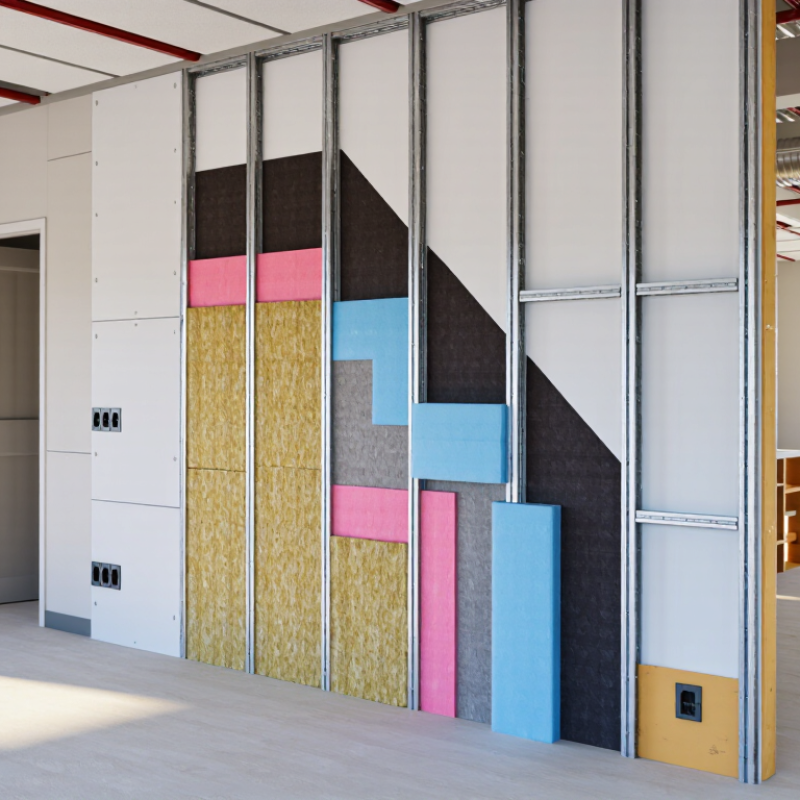
Interior partition walls, floor and ceiling cavities, external wall systems, plant rooms, and acoustic enclosures.
|
Common thicknesses: 50–150 mm.
Typical density: approximately 30–120 kg/m³, depending on the product and application.
Available as batts, slabs, or loose-fill products.
|
Effective for reducing airborne sound when friction-fitted without gaps. Higher density alone does not guarantee better sound insulation; the complete wall, floor, or ceiling system governs the final rating. Suitable products may also contribute to fire resistance.
|
Use the tested assembly rather than treating the insulation as a standalone rating. Avoid compression, voids, and flanking paths. Relevant references include EN 13162, ASTM C665, ASTM C423, ISO 10140, ASTM E90, and EN 13501-1 where applicable.
|
Mineral-based, durable, and often available with recycled mineral content. Verify the product-specific environmental product declaration, binder chemistry, dust-control information, and end-of-life pathway. Check whether the declared thermal and acoustic properties are based on third-party testing.
|
Confirm thickness tolerance, water-repellent treatment, facing requirements, fire classification, packaging compression, pallet dimensions, and local import classification. Request test reports for the exact density and thickness being purchased.
|
|
Glass Wool / Fiberglass
Lightweight
Flexible batts and rolls
|
Stud partitions, suspended ceilings, roof spaces, HVAC ducts, equipment rooms, and cavity floors.
|
Common thicknesses: 50–200 mm.
Typical density: approximately 10–60 kg/m³.
Supplied in rolls, batts, boards, or duct-liner formats.
|
Absorbs mid- and high-frequency sound within cavities. Performance depends strongly on cavity depth, air tightness, resilient connections, and the number and mass of board layers. It is generally not a substitute for sealing penetrations or controlling structural flanking.
|
Install continuously with no sagging or open joints. Protect exposed fibers where required by the specification. Common references include ASTM C665, ASTM C423, ISO 354, ISO 10140, ASTM E90, and EN 13162 for applicable products.
|
Low material weight can reduce transport impacts per square metre, while recycled glass content may be available. Compare EPDs using the same declared unit and life-cycle stages under ISO 14025 and EN 15804. Review indoor-air and handling documentation.
|
Check roll recovery, nominal versus installed thickness, facing type, moisture protection, compression during shipping, and installation safety instructions. For export shipments, compare volumetric freight cost because rolls can be bulky.
|
|
Cellulose Fiber
Recycled-fiber option
Loose-fill or dense-pack
|
Timber-frame walls, attic floors, roof cavities, retrofit walls, and irregular voids where blown installation is practical.
|
Loose-fill or dense-pack installation.
Installed density is project-specific and commonly falls approximately within 45–65 kg/m³ for dense-pack wall applications, subject to the system design.
|
Provides useful cavity absorption and can perform well in irregular spaces when installed at the specified density. Settlement, moisture, air leakage, and workmanship must be controlled. Acoustic results should be based on the complete tested assembly.
|
Use calibrated blowing equipment and follow the manufacturer’s installed-density requirements. Seal air paths before filling cavities. Relevant references include EN 15101-1 for loose-fill cellulose thermal insulation and ASTM C739 for cellulose fiber insulation where applicable.
|
Commonly manufactured from recycled paper fiber and may have a relatively low material mass. Verify fire-retardant treatment, borate or alternative additive disclosure, moisture behavior, recycled-content claims, EPD availability, and local recycling or disposal requirements.
|
Purchase the complete system rather than loose material alone when possible. Confirm installer training, blowing-machine calibration, density certificates, moisture limits, fire documentation, and availability of replacement material in the destination market.
|
|
Wood Fiber Insulation
Bio-based
Rigid or flexible boards
|
Timber construction, roof assemblies, external wall insulation, interior acoustic linings, and ventilated façade systems.
|
Common thicknesses: 40–160 mm.
Typical density: approximately 110–270 kg/m³, depending on flexible, semi-rigid, or rigid board format.
Moisture behavior varies by product construction.
|
Its mass and porous structure can provide sound absorption and damping, particularly in roof and wall assemblies. Acoustic performance depends on board density, joints, cavity design, sheathing, and the complete wall build-up.
|
Protect boards from prolonged rain and ground contact during storage and installation. Use compatible membranes and maintain required ventilation gaps. Refer to applicable EN product standards, ISO 10140, ISO 354, and EN 13501-1 classifications where declared.
|
Made primarily from renewable wood fibers and may store biogenic carbon; however, the result depends on forestry practices, binders, transport, service life, and end-of-life assumptions. Compare certified sourcing and product-specific EPDs rather than relying on generic claims.
|
Confirm moisture content, dimensional stability, fire classification, termite or pest requirements, edge profile, packaging protection, and compatibility with the local façade or roof system. Allow for climate-specific storage conditions.
|
|
PET / Polyester Fiber
Low-irritant handling
Interior acoustic panels
|
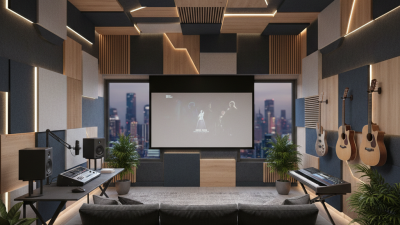
Office partitions, cinemas, studios, schools, open-plan interiors, wall panels, ceiling clouds, and exposed acoustic treatments.
|
Common thicknesses: 12–100 mm.
Typical density: approximately 20– unaff?
|
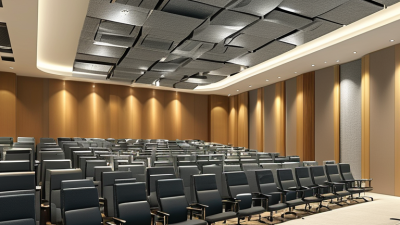
Strongest use is reverberation and echo control in rooms, especially at mid and high frequencies. It usually does not replace a mass-air-mass wall system for high airborne sound isolation.
|
Install with the specified air gap, adhesive, clips, or mechanical fixings. Evaluate room absorption using ISO 354 and ISO 11654 or ASTM C423 where applicable. Confirm reaction-to-fire classification for the intended interior location.
|
May contain recycled polyester and can be lightweight and reusable in panel form. Check recycled-content percentage, fiber shedding, flame-retardant chemistry, VOC information, cleaning durability, and recyclability at end of life.
|
Request absorption coefficients by frequency, not only a single NRC or weighted absorption value. Check color consistency, edge finish, moisture resistance, cleanability, minimum order quantities, and carton protection for international shipment.
|
|
Cork Board
Bio-based
Vibration-damping potential
|
Resilient underlays, floor impact-noise systems, wall linings, equipment isolation layers, and selected interior partitions.
|
Common thicknesses: 3–50 mm.
Typical density: approximately 100–250 kg/m³, depending on agglomerated or expanded cork construction.
|
Useful for impact-noise and vibration-control layers when designed as part of a resilient floor or equipment-isolation system. A thin cork board alone normally provides limited airborne sound isolation.
|
Keep dry and install on a clean, level substrate. Avoid rigid acoustic bridges around perimeter edges and service penetrations. Test floor impact performance using ISO 10140-3, ISO 16283-2, or ASTM E492 as appropriate.
|
Renewable bark material that can be harvested without cutting the tree. Verify forestry sourcing, adhesive content, fire performance, moisture resistance, service life, and whether the product is recyclable or compostable under local conditions.
|
Confirm dynamic stiffness, compressive creep, thickness recovery, impact-sound test results, adhesive compatibility, and suitability for the expected floor load. Check humidity limits during ocean freight and warehouse storage.
|
|
Resilient Acoustic Underlay
Impact-noise control
System component
|
Floating floors, apartment renovations, timber floors, raised-access floors, and machinery or equipment bases.
|
Common thicknesses: 3–20 mm.
Materials may include mineral fiber, rubber, cork, recycled elastomer, foam, or composite layers.
Key property: dynamic stiffness and long-term load behavior.
|
Designed mainly to reduce impact transmission. Results vary substantially with floor topping mass, perimeter isolation, joints, load, and flanking paths. It should be specified as part of a tested floor system.
|
Install without gaps, folds, or rigid bridges. Continue perimeter isolation as detailed and seal service penetrations carefully. Relevant references include ISO 10140-3, ISO 16283-2, ASTM E492, and ASTM E2179 where applicable.
|
Compare recycled content, durability under cyclic loading, chemical emissions, repairability, and end-of-life separation. A thinner product is not automatically more sustainable if it requires replacement or fails under load.
|
Request dynamic stiffness, compressive creep, point-load resistance, impact-improvement data, temperature range, and compatibility with adhesives or screeds. Confirm the declared performance for the exact floor construction.
|
|
Acoustic Spray Foam or Foamed Insulation
Air-sealing use
Not a complete soundproofing system
|
Sealing selected gaps, service penetrations, difficult joints, and limited cavity applications where the product is specifically approved.
|
Usually supplied as one- or two-component liquid systems that expand in place. Density, expansion ratio, curing time, and cell structure vary widely.
|
Can reduce leakage through small cracks when correctly applied, but it generally does not provide the mass, decoupling, or cavity absorption required for high sound isolation. Open-cell and closed-cell products have different acoustic and moisture behaviors.
|
Use only within the approved substrate, thickness, temperature, and ventilation range. Do not block required ventilation cavities or use around fire-rated penetrations without an approved tested detail. Check ASTM C1029, ASTM E84, EN 13501-1, or local equivalents as applicable.
|
Review blowing agents, global-warming potential, VOC emissions, fire behavior, service life, and disposal limitations. Material use should be minimized where a lower-impact sealant or mechanical detail can achieve the same result.
|
Obtain the safety data sheet, technical data sheet, fire test documentation, yield under local climate conditions, storage temperature requirements, and installer certification requirements. Do not accept generic “soundproof foam” claims without assembly testing.
|