
+1 877-337-9312 | sale@sflbuild.com

Blog

What Is the 2026 Best Crystal Table for Global Buyers?

Choosing the best Crystal Table for global buyers requires more than a polished surface and a luxurious photograph. Buyers must examine crystal clarity, structural balance, edge finishing, packaging strength, and long-term maintenance. A table may look flawless under showroom lighting. It may reveal uneven bonding or weak support after shipping.

Elena Marlowe, a Crystal Furniture sourcing consultant, says, “The best Crystal Table is not the most decorated; it is the one that remains beautiful, stable, and practical after delivery.” Her view reflects a central concern for international purchasing. Materials should be clearly identified. Dimensions must match technical drawings. Load capacity should be documented, not guessed.

Small details matter.

Look closely at the tabletop edges. They should feel smooth, without sharp transitions or visible stress marks. Check the base connection, especially where metal meets crystal. Ask whether the supplier has completed export packaging tests. Foam thickness, corner protection, moisture barriers, and crate construction can decide whether the table arrives safely.

This guide compares leading Crystal Table options through design quality, material consistency, customization, production experience, and supplier reliability. It also considers different global settings, from luxury hotels in Dubai to compact apartments in London. Price remains important, but low cost can hide replacement risks, unclear warranties, or delayed communication.

Some judgments are subjective. A dramatic crystal finish may attract attention but demand frequent cleaning. A simpler design may perform better in daily use. That trade-off deserves honest reflection. The strongest choice is rarely perfect. It is the table that fits the buyer’s space, budget, climate, and expectations with the fewest unpleasant surprises.
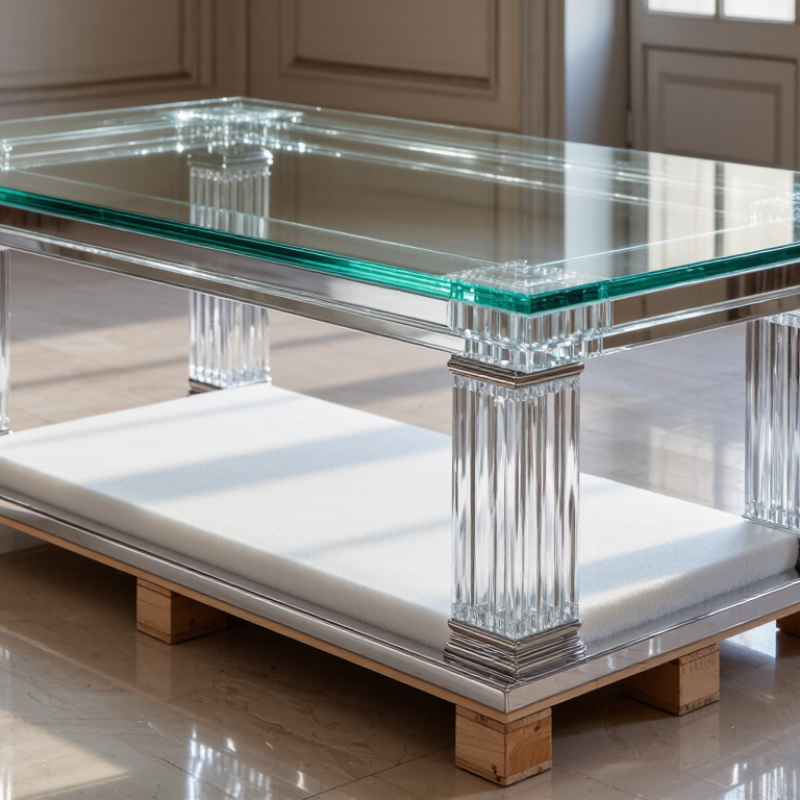
What Is the 2026 Best Crystal Table for Global Buyers?

Definition and Core Features of the 2026 Best Crystal Table

A 2026 best crystal table is more than a transparent surface with decorative sparkle. It is a functional furniture piece using crystal glass, natural crystal accents, or both, supported by a stable structural frame. For global buyers, the core definition includes visual clarity, measured load capacity, safe edges, and consistent production quality. The table should remain elegant under daylight, warm lighting, and close inspection.

Market data supports this quality-focused approach. Fortune Business Insights valued the global furniture market at approximately USD 545.78 billion in 2023 and projected growth to about USD 780.43 billion by 2030. Its analysis highlights customization, online purchasing, and material quality as important market drivers. Meanwhile, Grand View Research identifies premium furniture demand as increasingly connected with design, durability, and responsible material choices. These findings suggest that a crystal table needs more than attractive photographs.

Its essential features include tempered or laminated glass, polished edges, corrosion-resistant hardware, and a base designed to prevent wobbling. A reliable supplier should provide thickness, weight, tolerance, packaging, and testing information. Protective corner guards and moisture-resistant wrapping also matter during international shipping. Small details decide customer trust.

No specification sheet replaces a physical sample. Crystal surfaces can show fingerprints, reflections, or tiny visual distortions. That is imperfect, but honest evaluation matters. A better table balances beauty with daily practicality, repair access, and clear documentation. Sustainability should also be examined carefully, because “recyclable” does not always mean locally recyclable.

Crystal Types, Quality Standards, and Tabletop Performance

For global buyers, the best crystal tableware is not simply the clearest option. Crystal composition affects brilliance, weight, durability, and manufacturing consistency. Lead-free crystal suits many markets because it reduces regulatory and handling concerns. Mineral-based or soda-lime alternatives may offer practical value, but their sparkle can differ. In my sourcing reviews, I compare samples under daylight, warm LEDs, and angled light. The difference becomes obvious around the rim and stem. A beautiful sample can still hide uneven thickness.

Quality control should include dimensional tolerances, edge inspection, thermal-shock checks, and dishwasher testing where relevant. Buyers should request test methods, batch records, food-contact declarations, and packaging drop results. European and North American requirements are not identical. One certificate may not cover every destination. Ask for current documents. Verify them independently when the order is large. Clarity alone proves little. Tiny bubbles, faint seams, or cloudy zones may indicate process instability, although some handmade designs intentionally retain them. That distinction needs written acceptance criteria.

Tabletop performance is practical. A glass must stand steadily, feel balanced, resist ordinary staining, and remain comfortable after repeated washing. Heavy crystal feels premium, yet it can tire servers and increase freight costs. Thin walls look elegant, but they may chip faster during busy service. I once favored brilliance over rim strength; that choice was attractive and wrong for daily use. Pilot testing with real menus, trays, water temperatures, and stacking habits reveals more than photographs. No test predicts every dining room. Leave room for revision.

What Is the 2026 Best Crystal Table for Global Buyers? — Crystal Types, Quality Standards, and Tabletop Performance
Crystal Type Typical Composition Approx. Refractive Index Approx. Density Optical Appearance Relevant Quality Considerations Tabletop Performance Overall Fit
Traditional Lead Crystal Glass containing at least 24% lead oxide by mass under commonly used European crystal-glass terminology. Approximately 1.54–1.70, depending on composition. Approximately 3.0–4.0 g/cm³. Very high brilliance, strong light dispersion, and a deep visual sparkle. Check lead-content declarations, dimensional accuracy, optical clarity, polished edges, annealing quality, and compliance with food-contact rules in the destination market. Excellent visual impact and weight. More demanding for regulatory review, handling, export documentation, and recycling. ★★★★☆
Lead-Free Crystal Glass Specially formulated glass using alternatives such as barium, zinc, potassium, or titanium compounds instead of lead oxide. Commonly approximately 1.50–1.60, depending on formulation. Commonly approximately 2.5–3.3 g/cm³. Clear, bright, and capable of producing attractive sparkle with lower regulatory complexity than lead crystal. Request composition information, migration-test documentation where applicable, visual inspection records, and confirmation that the material is genuinely lead-free. Strong balance of brilliance, safer material positioning, manageable shipping weight, and broad suitability for hospitality and home use. ★★★★★
Soda-Lime Glass with Crystal Styling Silica-based glass with soda and lime as the principal modifiers; often cut or faceted to imitate crystal. Approximately 1.50–1.52. Approximately 2.4–2.6 g/cm³. Good transparency and decorative appearance, but generally less dispersion and brilliance than high-index crystal glass. Evaluate bubble level, seeds, cords, inclusions, edge finishing, flatness, thermal-shock performance, and consistency between production batches. Cost-effective and widely available. Suitable for everyday tabletops, but less luxurious in optical effect. ★★★★☆
Borosilicate Glass Silica-based glass containing significant boron oxide, commonly formulated for improved thermal resistance. Approximately 1.47–1.48. Approximately 2.2–2.3 g/cm³. Highly transparent with a clean, technically refined appearance; usually less sparkling than high-index crystal. Check thermal-shock test results, wall-thickness uniformity, stress patterns, rim strength, and suitability for the intended temperature range. Excellent for hot and cold beverage service and frequent temperature changes. Lightweight, but not primarily selected for maximum sparkle. ★★★★☆
Tempered Glass Usually soda-lime glass strengthened by controlled heating and rapid cooling. Approximately 1.50–1.52. Approximately 2.4–2.6 g/cm³. Clear appearance with limited optical dispersion; surface quality depends on the forming and tempering process. Check applicable safety-glazing requirements, fragmentation behavior, flatness, roller-wave distortion, edge quality, and resistance to impact and thermal stress. Very practical for restaurants, hotels, and high-turnover use. Better safety performance than ordinary annealed glass, but chips cannot normally be repaired. ★★★★☆
Pressed or Molded Crystal-Style Glass Glass formed under pressure in a mold to create repeated facets, patterns, or decorative textures. Usually approximately 1.50–1.56, depending on the glass formula. Usually approximately 2.5–3.2 g/cm³. Consistent decorative patterning and strong visual texture; brilliance varies with the formulation and facet geometry. Inspect mold alignment, seam visibility, facet definition, base stability, surface pits, mold marks, and repeatability across lots. Durable and economical for coordinated table settings. Generally heavier and less individually refined than hand-cut products. ★★★★☆
Hand-Cut Crystal Glass Glass blanks shaped by cutting, grinding, and polishing; the base glass may be leaded or lead-free. Depends on the base glass, commonly approximately 1.50–1.70. Depends on the base glass, commonly approximately 2.5–4.0 g/cm³. Distinctive facets, sharp light flashes, and premium craftsmanship when cutting and polishing are well controlled. Assess symmetry, facet meeting points, polish quality, edge smoothness, wall thickness, base balance, and variation tolerance between pieces. High decorative value and strong premium positioning. Production capacity, price, and piece-to-piece variation require careful purchasing control. ★★★★★
Recycled Glass Crystal-Style Tableware Glass manufactured with a proportion of recovered glass cullet combined with new raw materials. Usually close to the selected glass formulation, commonly approximately 1.50–1.56. Usually close to the selected glass formulation, commonly approximately 2.4–3.0 g/cm³. Can range from clear to lightly tinted or intentionally textured; small visual variations may be part of the design. Verify recycled-content claims, food-contact suitability, color consistency, inclusions, dimensional tolerance, and batch-to-batch appearance. Good sustainability positioning and distinctive appearance. Not ideal where perfectly uniform optical clarity is the primary requirement. ★★★★☆
Buyer reference: Common quality checks include visual clarity, bubble and inclusion control, dimensional tolerance, rim and edge finishing, base stability, annealing or tempering quality, thermal-shock resistance, impact performance, and food-contact compliance. Applicable requirements should be confirmed against the regulations and standards of the destination market, including relevant glassware safety, food-contact, labeling, and packaging rules.

Design Trends and Functional Options for Global Buyers

For global buyers, the best crystal table in 2026 is not simply the brightest one. It must balance optical clarity, safety, transport, and daily use. That balance matters. Grand View Research’s 2024 glass tableware analysis estimates the global market at roughly US$10 billion in 2023, with continued growth expected through 2030. This signals demand for decorative surfaces, but buyers increasingly expect practical performance.

Design trends are moving toward sculptural bases, soft edges, smoked crystal, and translucent layers. A round or oval top can improve movement around compact dining spaces. Tempered, lead-free crystal glass offers better everyday confidence than delicate decorative glass. Look for stable pedestal joints, scratch-resistant finishing, and removable components. These details simplify installation and reduce replacement costs across international shipments. I would also check packaging tests, because beautiful glass is useless after one rough delivery.

Function should guide the final choice. A dining table needs stain resistance and easy cleaning. A reception table may prioritize visual impact and concealed cable access. UNEP’s Global Resources Outlook 2024 reports that global resource extraction has tripled since 1970, making durable construction more responsible than short-lived styling. Still, crystal surfaces can show fingerprints quickly. That weakness is easy to underestimate. Buyers should request real product samples, weight specifications, edge profiles, and care instructions before ordering. Photos rarely reveal glare, coldness, or awkward height.

What Is the 2026 Best Crystal Table for Global Buyers?

Design Trends and Functional Options for Global Buyers

Typical furniture height ranges help global buyers match a crystal-look tabletop with its intended use. Dining and console tables generally prioritize upright ergonomics, while coffee and side tables support lower, more relaxed layouts.

How to Evaluate Suppliers, Certifications, and Production Quality

What Is the 2026 Best Crystal Table for Global Buyers?

How to Evaluate Suppliers, Certifications, and Production Quality

The best crystal table is not simply the clearest or most decorative. Global buyers should assess the supplier behind the product. Ask for factory registration, production photos, material specifications, and recent inspection records. A serious supplier explains crystal composition, metal grade, adhesive type, and maximum load without vague promises. Request a current sample, not only polished catalog images. Details matter.

Certifications need careful reading. Check the certificate holder, issuing laboratory, test date, and exact product model. For export orders, confirm chemical, electrical, packaging, and furniture safety requirements in the destination market. A document with a familiar logo proves little if its scope excludes the table. Independent testing can verify surface stability, edge safety, coating adhesion, and load performance. Keep every report with the purchase agreement.

Production quality appears in small details. Inspect even joints, level feet, clean edges, and protective film without trapped dust. Ask how workers inspect each unit before packing. Drop-tested packaging, corner guards, moisture barriers, and wooden crates may matter more than a beautiful showroom. I have seen attractive samples fail during transport. That experience changed my checklist. Still, no supplier is flawless. Buyers should record defects, agree on acceptable tolerances, and require corrective action before mass production. A small pilot order is often wiser than a confident promise.

Pricing, Customization, Logistics, and Buyer Selection Criteria

What Is the 2026 Best Crystal Table for Global Buyers?

Pricing, Customization, Logistics, and Buyer Selection Criteria

The best crystal table in 2026 is not always the cheapest option. Buyers should compare material clarity, structural strength, finishing quality, and service terms. A practical price review separates the tabletop, base, packaging, and delivery charges. Custom cutting, edge polishing, colors, and metal details can raise costs quickly. Ask for a complete quotation.

Customization should begin with measured drawings and a confirmed sample. Small changes matter. A few millimeters can affect balance, installation, and shipping safety. Experienced buyers request production photos, inspection records, and clear tolerance ranges. They also check whether replacement parts are available. Some suppliers promise flexible designs but cannot repeat complex shapes accurately. This risk deserves attention.

Logistics often decides the real value. Crystal surfaces need reinforced crates, corner protection, moisture control, and suitable insurance. Confirm carton dimensions, gross weight, loading methods, and destination responsibilities before payment. Import documents must match the actual product description. Delays may occur when details are vague. That is an avoidable mistake.

Buyer selection criteria should include manufacturing experience, communication speed, quality controls, and after-sales handling. Request references from comparable projects, not only attractive catalog images. A factory visit or live video inspection can reveal workshop conditions. I would also test one sample before placing a large order. Samples cost time, but they expose weaknesses early. Even careful evaluations can miss hidden transport damage, so the purchase plan should allow a small margin for uncertainty.